
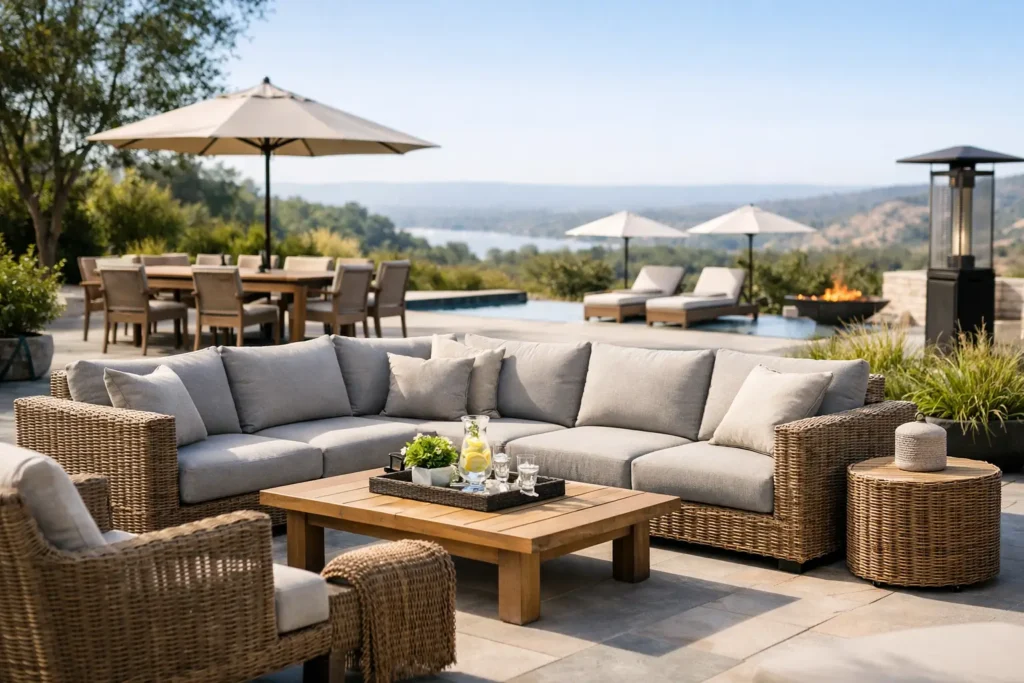
A pool deck can look exceptional on opening day and underperform by the end of the season. Cushions lose shape, finishes fade unevenly, tables wobble on textured paving, and a once-cohesive terrace starts to feel patched together. That is why an outdoor hospitality furniture guide matters for commercial projects – not as a style exercise, but as a specification tool that protects guest experience, operating efficiency, and long-term value.
In hospitality settings, outdoor furniture carries more pressure than many buyers expect. It needs to support brand image, handle constant use, tolerate weather exposure, and stay serviceable without becoming a maintenance burden. For hotels, country clubs, restaurants, rooftop bars, and resort environments, the right selection is rarely about choosing the most attractive chair in a catalog. It is about building a coordinated outdoor scheme that performs across layout, durability, comfort, and budget.
What this outdoor hospitality furniture guide should help you solve
Commercial buyers usually face the same tension points. Designers want a distinct visual identity. Operators want furniture that can survive daily turnover. Procurement teams need cost control and predictable lead times. Owners want all of that without compromising the standard of the space.
A strong specification balances those priorities early. If the furniture package is considered only at the end of the project, compromises tend to show up everywhere: mismatched materials, oversized pieces that restrict circulation, or attractive products that are unsuitable for exposed conditions. Outdoor hospitality furniture has to be selected as part of the operating environment, not treated as an accessory layer.
Start with the setting, not the product
The first question is not whether you need dining chairs, loungers, or barstools. It is how the space actually functions. A shaded courtyard at a boutique hotel has very different demands from a beachfront restaurant or an open-air members’ club terrace.
Exposure changes everything. Direct sun affects heat retention, color fastness, and fabric longevity. Rain exposure influences drainage and drying time. Coastal conditions introduce salt corrosion. High-rise rooftops may deal with stronger wind loads and more frequent repositioning. Even cleaning practices matter. If the operations team regularly pressure-washes surfaces, some finishes and construction types will age faster than expected.
This is where many furniture decisions go right or wrong. A product can be suitable for “outdoor use” in general terms and still be the wrong choice for a specific hospitality environment. Commercial buyers need to evaluate furniture against actual site conditions, not broad product claims.
Design consistency matters more than single hero pieces
Hospitality buyers are often tempted by standout pieces that photograph well but create inconsistency across the wider scheme. In practice, guests experience the full setting, not isolated products. The relationship between dining seating, lounge seating, side tables, bar tables, and sun loungers shapes the atmosphere far more than one statement chair.
For that reason, collection-based sourcing often makes more sense than piecemeal buying. When furniture is selected from coordinated families or style-aligned ranges, the result feels intentional. That consistency is especially valuable for larger projects where outdoor zones flow into indoor lounges, restaurants, event spaces, or guest amenities.
The commercial advantage is practical as well as visual. Matching construction language, finish tones, and upholstery direction makes replenishment easier later. If a venue expands or replaces units in phases, a coherent collection reduces the risk of visible mismatch.
Materials: what works, what depends
Material choice is where design ambition meets operating reality. There is no single best option. The right specification depends on climate, maintenance capacity, guest profile, and price point.
Powder-coated aluminum remains a strong choice for many hospitality projects because it is relatively lightweight, corrosion resistant, and adaptable across modern design styles. It suits dining and lounge applications well, especially where staff need to move furniture for service resets or events. That said, not all powder coating performs equally. Surface preparation and finish quality make a real difference in how well the product holds up over time.
Synthetic wicker still has a place in hospitality, particularly when a softer, resort-led look is required. The key is selecting commercial-grade weave with a durable frame beneath it. Lower-grade options can become brittle, sag, or lose visual crispness, which quickly affects the perceived quality of the venue.
Teak and other timber finishes can add warmth and premium character, especially in luxury terraces and poolside environments. But timber asks for a realistic maintenance conversation. Some operators welcome the weathered patina that develops over time. Others want a consistent original tone, which means ongoing care. Neither approach is wrong, but expectations need to be aligned before specification.
Outdoor upholstery and sling materials deserve just as much scrutiny. Fabrics need to resist fading, moisture retention, and heavy commercial use. Comfort matters, but so does dry-back time. Deep cushions may feel luxurious, yet they can create operational headaches in exposed areas if they take too long to dry after rain.
Comfort drives dwell time and spend
In hospitality, furniture comfort is not a secondary detail. It directly affects how long guests stay, how they use the space, and how they rate the experience. A restaurant chair can be visually refined, but if it lacks the right seat depth or back support, guest turnover may become unintentionally rushed. That may help in some fast-paced formats, but it works against premium dining, clubs, and hotel lounges where dwell time often supports higher spend.
The same applies to outdoor lounge settings. Low seating can look relaxed and upscale, yet if it is difficult for older guests to get in and out of, the space becomes selective rather than welcoming. Hospitality furniture should support the intended mood without creating friction for actual users.
This is why showroom evaluation still matters. Dimensions on a spec sheet are useful, but real-world testing often reveals issues that paper selection misses. Seat height, arm profile, table proportion, and cushion firmness all affect whether a piece truly fits the project.
Layout and mobility need commercial thinking
An attractive outdoor setup can still fail operationally if circulation is too tight or furniture is too cumbersome. Service teams need enough room to move safely and efficiently. Guests need clear pathways, especially in mixed-use spaces where dining, waiting, and casual lounging overlap.
Furniture weight is one of the most overlooked decisions. Heavier pieces may feel premium and remain stable in wind-prone environments, but they can slow down daily resets. Lighter pieces improve flexibility, though they may require more careful planning in exposed locations. Stackability and nesting are equally relevant for venues that host events or need to reconfigure spaces often.
There is always a trade-off here. The best-looking option is not automatically the best operational option, and the most practical product is not always right for the brand experience. The goal is to specify furniture that respects both.
Budget control without short-term thinking
Price discipline matters on every project, but outdoor hospitality furniture should not be evaluated on unit cost alone. Lower-priced products may appear efficient at tender stage, then become expensive through replacement cycles, maintenance issues, or guest-facing wear.
A better approach is to compare value across lifespan, maintenance demands, finish resilience, and visual longevity. Buyers should also think in terms of the full package. Coordinated sourcing across outdoor dining, lounge, bar, and occasional furniture often creates better budget efficiency than buying from multiple fragmented sources.
For project teams, supplier reliability is part of the value equation. Consistent quality, the ability to customize where needed, and support across specification, sampling, and delivery can reduce delays and rework. That matters as much as product aesthetics when timelines are tight.
A practical outdoor hospitality furniture guide for specification teams
When shortlisting options, focus on a few commercial questions. Will the furniture suit the exact exposure conditions? Does it align with the brand character of the venue? Can it be maintained by the operations team without special complexity? Is there collection depth to support multiple zones with a consistent look? And can the supplier support project quantities, customization, and repeat orders if the site evolves?
For many hospitality projects, the strongest outcomes come from working with a partner that understands full-space specification rather than isolated product sales. That includes helping buyers coordinate styles across categories, assess trade-offs honestly, and build packages that are commercially sound. For businesses furnishing hotels, clubs, and F&B spaces, that kind of support saves time and reduces risk. It is one reason buyers turn to experienced project suppliers such as VCUS when they need stylish, functional furniture that performs in real operating environments.
The best outdoor spaces do not feel overdesigned or overengineered. They simply work – visually, operationally, and commercially – season after season. When furniture is specified with that standard in mind, the result is not just a better terrace or patio, but a stronger hospitality experience from the first impression onward.
