
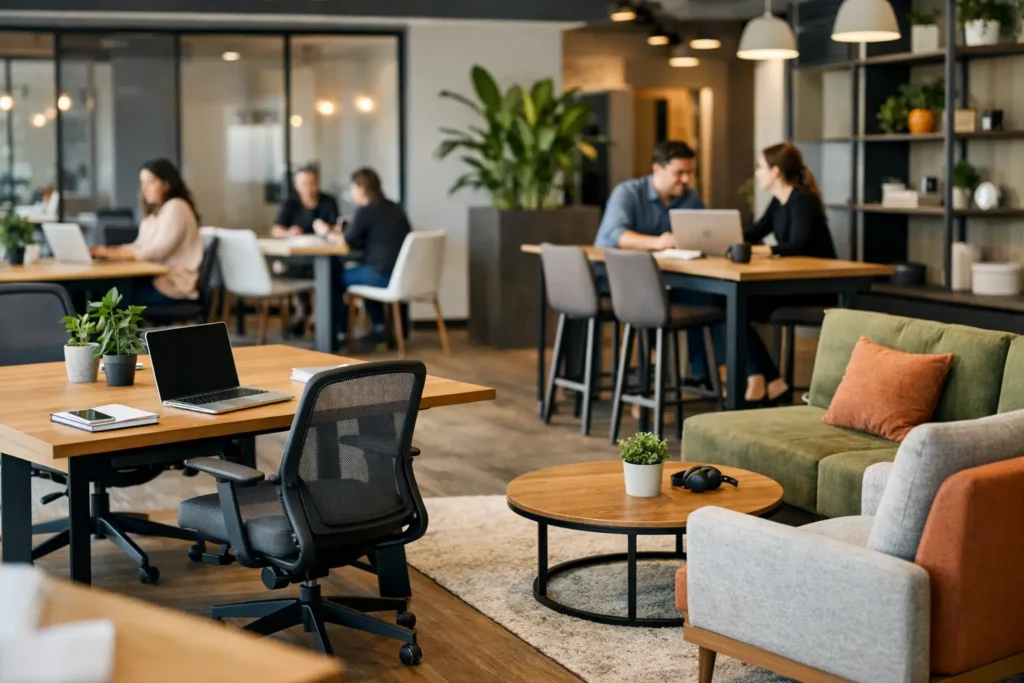
A coworking space tells people what kind of work can happen there before anyone plugs in a laptop. If the furniture is too rigid, too casual, or too fragile for daily turnover, the space starts working against its operators. That is why what furniture works for coworking spaces is not just a styling question. It is a planning decision that affects occupancy, member satisfaction, maintenance costs, and how easily the space can evolve.
For owners, designers, and procurement teams, the right answer usually is not one hero product. It is a coordinated mix of workstations, meeting settings, lounge seating, café-style pieces, and support furniture that gives members real choice throughout the day. The best coworking environments feel intuitive because every furniture category has been selected around behavior, durability, and visual consistency.
What furniture works for coworking spaces in practice
Coworking spaces serve multiple user types at once. A freelancer taking calls, a startup team running a sprint, and a corporate satellite group meeting clients may all use the same floorplate in one day. Furniture has to support that range without making the interior feel cluttered or inconsistent.
That usually means specifying pieces that are flexible but not temporary-looking. Mobile tables can be useful, but if every item feels lightweight and improvised, the brand experience suffers. On the other hand, fixed furniture can create order, though too much of it limits future reconfiguration. The strongest schemes balance anchored zones with adaptable elements.
A dependable specification often includes benching or shared desks for hot-desking, ergonomic office chairs for longer sessions, meeting tables in several sizes, upholstered lounge seating for informal work, café tables for quick touchpoints, and bar-height options for shorter stays or casual collaboration. Storage, acoustic screens, and power-integrated tables also matter because utility shapes whether a space feels professional.
Start with activity zones, not individual products
Furniture selection is easier when the layout is broken into work modes. Coworking users rarely stay in one posture or one setting all day. They move between focused work, calls, casual conversations, private meetings, social moments, and waiting areas. Each zone needs its own furniture logic.
Focused work areas need stable desks, supportive task seating, and enough separation to reduce visual and acoustic distraction. This is where quality matters most. If members are expected to work for several hours, desk depth, chair ergonomics, and tabletop durability cannot be treated as secondary details.
Collaborative zones need tables that can handle laptops, notebooks, and group discussion without feeling oversized. In many projects, rectangular meeting tables and round discussion tables work together well because they support different interaction styles. Round tables soften the room and encourage equal participation, while rectangular tables are more efficient for formal team use.
Lounge zones should not be treated as decorative leftovers. They are often where first impressions are made and where members choose to spend informal working time. Sofas, lounge chairs, and coffee tables need proportions that support actual use, not just photographs. Seats that are too low or too deep may look inviting but do not help people work comfortably.
Desking that supports turnover and long hours
In most coworking projects, desks carry the operational load. They need to look clean, withstand frequent use, and allow straightforward maintenance. Shared desks should be sized for practical spacing, cable management, and easy cleaning between users.
For open-plan areas, modular desk systems are often the most efficient choice because they make it easier to scale capacity while keeping the visual language consistent. They also help procurement teams maintain continuity when the operator expands or refreshes part of the floor later. If privacy is a concern, desk-mounted screens or modest dividers can improve comfort without building hard barriers everywhere.
Private offices within coworking environments may justify a more executive feel, but that does not mean overfurnishing. A practical desk, ergonomic chair, compact storage, and a guest seat are usually enough. Too many pieces reduce flexibility and make smaller rooms feel cramped.
Sit-stand desks can add value, especially in premium memberships or dedicated office suites. The trade-off is budget. They are not always necessary across an entire project, but they can be a smart differentiator in selected zones where user retention matters.
Seating is where quality shows fastest
If there is one category that reveals whether a coworking fit-out was value-engineered too aggressively, it is seating. Members will forgive many things before they forgive an uncomfortable chair. Office seating for primary work areas should be adjustable, supportive, and built for commercial use.
This does not mean every chair has to be high-cost task seating. It means matching the chair to dwell time. Dedicated desks and bookable workstations need stronger ergonomic performance than touchdown areas or café corners. Meeting rooms can use simpler but still supportive chairs, while barstools and lounge chairs suit shorter sessions.
Material choice matters here as well. Upholstered seating can warm up a space and elevate the design language, but it should be specified with maintenance in mind. High-turnover environments benefit from commercial-grade fabrics, cleanable surfaces, and frames that hold up under constant movement. Designers often focus on silhouette first, but operations teams will feel the difference in upkeep almost immediately.
Lounge and social furniture should still earn its footprint
Good coworking spaces do not separate work and hospitality as if they are opposites. Members increasingly expect comfort, but comfort in commercial interiors has to perform. Lounge furniture should create softer working options, waiting areas, and informal meeting points while still aligning with circulation and density targets.
A mix of two-seater sofas, lounge chairs, ottomans, and compact occasional tables often works better than oversized residential-looking sets. Smaller-format pieces give operators more flexibility to reshape zones over time. They also help maintain visual order in shared environments where too much bulk can make a floor feel heavy.
Café-style tables and banquette seating can be especially effective near pantry or social areas because they give members another place to work without occupying formal desks. In projects that blur office and hospitality design, these pieces help create a richer experience while keeping the furniture program efficient.
Meeting and phone booth support furniture matters more than many expect
Coworking spaces rise or fall on whether members can take calls and hold meetings without friction. Furniture plays a direct role here. Meeting rooms need tables sized appropriately for the room, not simply the maximum number of chairs that can be squeezed in. Poor proportions make rooms uncomfortable and less bookable.
Small meeting spaces often benefit from round tables or compact rectangular tables with light-profile chairs. Larger rooms may need boardroom-style layouts, but even then the emphasis should be on easy movement, cable access, and durable finishes.
Phone booths and quiet pods also need proper seating surfaces, mini worktops, and stable materials. These are not secondary accessories. In many coworking operations, they are some of the hardest-working spaces on the floor.
Durability, cleanability, and replacement planning
Design-forward furniture is important, but coworking is a high-use commercial model. Pieces should be selected for lifecycle value, not just opening-day appeal. Laminate, veneer, powder-coated metal, performance upholstery, and contract-grade plastics all have a role depending on the zone and the level of use.
It also helps to think in terms of replacement strategy. Can chairs be reordered later in the same finish? Can tabletops or upholstery be refreshed without replacing an entire set? Can matching pieces be specified across lounge, work, and meeting zones to simplify future phases? These are the kinds of practical decisions that protect both brand consistency and budget discipline.
For that reason, many professional buyers prefer a supplier that can support multiple categories under one coherent design direction. A coordinated range reduces the risk of mismatched tones, inconsistent quality levels, and fragmented lead times. For project-based buyers, that reliability matters as much as aesthetics.
Style still matters because coworking is a brand experience
Furniture for coworking spaces has to perform, but it also has to sell the environment. Prospective members often compare spaces quickly. They notice whether the interior feels current, intentional, and professionally finished. A cohesive furniture scheme signals trust.
That does not mean every coworking brand should look the same. Some projects benefit from a sharper corporate expression, while others lean warmer and more hospitality-led. The key is consistency across categories. Workstations, lounge seating, tables, and barstools should feel like they belong to the same story.
This is where a curated commercial approach becomes valuable. VCUS supports project teams that need stylish and functional furniture across categories, with the flexibility to create a consistent look without pushing the budget beyond what the business model can support.
The best furniture for coworking spaces is rarely the most expensive or the most trend-driven. It is the furniture that helps people work well, gives operators flexibility, and keeps the space looking credible after heavy daily use. When every zone is planned around real behavior and long-term performance, the interior does more than look good on launch day. It stays useful, adaptable, and worth returning to.
