
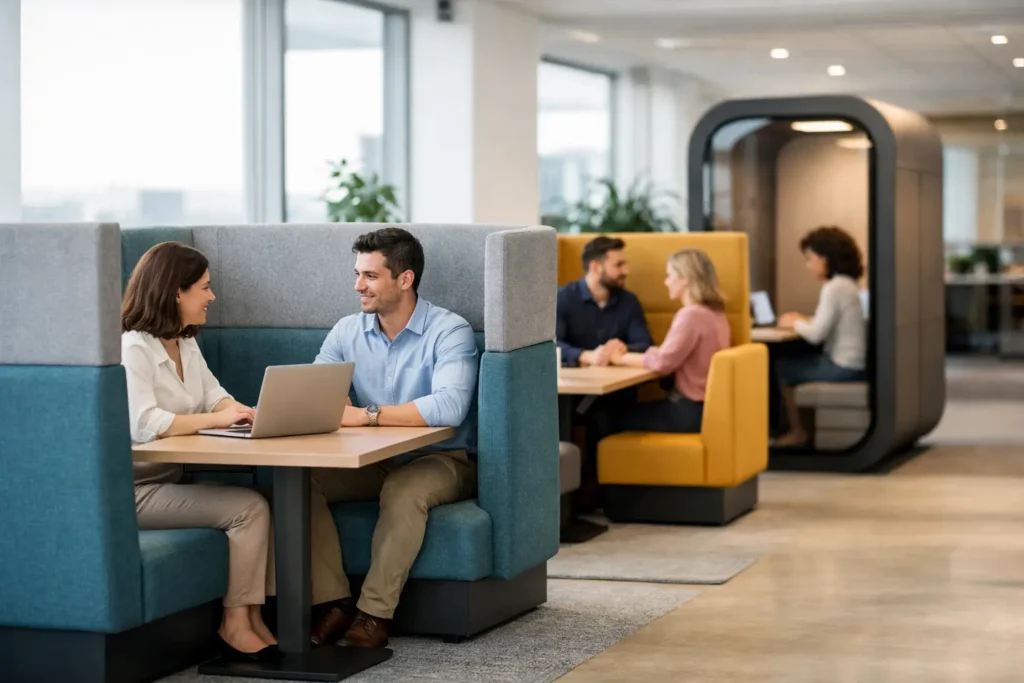
Open-plan offices look efficient on paper. In practice, they often leave teams hunting for a quiet corner, a quick meeting spot, or somewhere to focus without booking a formal room. That is why office booth seating ideas have become a practical priority for designers, procurement teams, and business owners planning workplaces that need to perform every day.
Booth seating is no longer limited to cafeteria-style banquettes or novelty pods. In commercial office settings, it has become a flexible planning tool that helps shape circulation, support hybrid work, and create more usable square footage without the cost and permanence of building new rooms. When specified well, booth seating adds privacy, acoustic comfort, and a stronger visual structure to the floorplate.
For project teams, the real question is not whether booth seating belongs in the workplace. It is which type belongs where, and how to make sure it aligns with the wider furniture scheme, usage patterns, and budget.
Office booth seating ideas for different zones
The strongest booth seating concepts start with zoning. A booth that works well in a touchdown area may fail completely in a client-facing lounge, and a collaborative booth near a work café will not solve the same problem as a high-back unit placed beside open desks.
In focused work zones, enclosed or semi-enclosed booths help reduce visual distraction and soften surrounding noise. These are useful for individual concentration, video calls, or one-on-one conversations when there are not enough enclosed rooms. The trade-off is footprint. Higher acoustic sides create privacy, but they also make the piece feel more substantial, so spacing and sightlines need attention.
In collaboration areas, booth seating works best when it supports short meetings and informal problem-solving. A facing sofa booth with an integrated table is often more efficient than scattering lounge chairs around a coffee table. It gives teams a clear place to gather, keeps posture more task-friendly, and avoids the awkwardness of balancing laptops on soft seating.
Reception-adjacent spaces call for a different approach. Here, booth seating should feel polished and brand-aligned without becoming overly casual. Cleaner profiles, durable upholstery, and carefully chosen finishes matter more than maximum enclosure. You want comfort and quiet, but you also want a setting that presents well to guests and clients.
Work cafés and multipurpose breakout spaces are where banquette-style booth seating earns its keep. It can define the edge of a zone, seat more people efficiently, and create a hospitality-led atmosphere that still supports work. In these settings, cleanability and stain resistance become just as important as style.
1. High-back privacy booths for focused tasks
A high-back booth is one of the most effective answers to the acoustic weaknesses of open-plan offices. With taller side and back panels, it creates a visual and sound buffer that helps people focus, take calls, or hold quick conversations without moving to a meeting room.
This format is especially useful in offices where enclosed rooms are in short supply. It gives staff a practical intermediate setting between a desk and a formal conference space. For specifiers, the key details are seat comfort, table height, integrated power access, and upholstery that can handle heavy use. If the booth is too soft or too low, it starts looking attractive but functioning poorly.
2. Facing booths with tables for team huddles
For departments that need frequent, informal check-ins, a face-to-face booth with a central table offers better usability than a casual lounge cluster. It supports laptops, notebooks, and short collaborative sessions while maintaining a compact footprint.
This is one of the most dependable office booth seating ideas for project rooms, sales floors, and shared team neighborhoods. It encourages faster meetings and keeps small-group discussions from spilling into circulation paths. The balance to strike is density versus comfort. Squeezing in extra seating may improve capacity on paper, but if elbow room is tight, people will avoid using it for real work.
3. Modular booth runs for open-plan flexibility
Modular systems are ideal when a workplace needs consistency across multiple zones. A modular booth run can be configured as a straight banquette, an L-shape, a back-to-back arrangement, or a semi-enclosed collaboration setting using the same design language.
This matters for larger fit-outs, where visual cohesion across departments and common spaces helps the workplace feel intentional rather than pieced together. Modular formats also make it easier to scale later. If a client adds a new project area or reworks a breakout zone, matching pieces can often be specified without redesigning from scratch.
The practical consideration is planning discipline. Modular systems reward careful space planning but can become inefficient if dimensions are forced into awkward layouts. Early coordination between designer, contractor, and furniture supplier saves time here.
4. Banquette seating along perimeter walls
Not every booth needs to sit in the middle of the floor. Banquette-style booth seating placed along perimeter walls is an efficient way to create compact meeting or touchdown areas while preserving circulation.
This approach suits offices where every square foot matters. It also works well in mixed-use environments, such as executive lounges, pantry spaces, and client waiting areas that need to transition between hospitality and work functions. A wall-side banquette can be paired with movable chairs and tables for flexibility, or fixed tables where consistency matters more.
The upside is space efficiency. The downside is lower privacy than a high-back freestanding booth. If acoustic control is a priority, material selection and nearby zoning become more important.
5. Back-to-back booths to divide space
Back-to-back booth configurations are useful when you need furniture to do more than seat people. They can act as soft dividers between neighborhoods, separating collaborative and quiet zones without hard construction.
For open-plan offices, this creates a more structured environment with fewer visual interruptions. It can also improve traffic flow by giving circulation routes a clearer edge. When combined with consistent upholstery, table finishes, and surrounding loose furniture, back-to-back booths help large workspaces feel organized and professionally resolved.
These units do require enough clearance around them to avoid making the floor feel cramped. In tighter offices, a slimmer profile may be a better choice than a deeply upholstered model.
6. Compact single-user booths for calls and touchdown work
Not every problem needs a four-seater solution. Single-user booths with modest enclosure are highly effective in hybrid workplaces where employees move through the office for focused bursts of work, calls, and short laptop sessions.
These pieces are especially useful near shared desks, circulation hubs, and executive support areas. They give staff a quick retreat without requiring a room booking. If power integration is included, they become even more valuable as practical work points.
The common mistake is treating these as decorative extras. In reality, they need the same ergonomic attention as any task-oriented seating. Seat depth, work surface height, and access to charging all affect whether the booth gets used consistently.
7. Hospitality-style booths for client-facing spaces
Some offices want booth seating to do more than support internal work. In reception lounges, executive waiting areas, and meeting suites, booth seating can help create a more refined visitor experience while still offering functional privacy.
This is where design-forward detailing has real commercial value. Upholstery texture, stitching, timber or metal accents, and coordinated tables all contribute to a stronger first impression. For architects and interior designers, this type of booth also creates a bridge between workplace and hospitality language, which is increasingly relevant in premium office environments.
The trade-off is maintenance. More expressive finishes need to be selected with long-term wear in mind, particularly in high-contact areas.
What to check before you specify booth seating
The best office booth seating ideas succeed because they answer operational questions, not just aesthetic ones. Before specifying, it helps to confirm how long people will sit there, whether they will use laptops, whether conversations need acoustic shielding, and how often the upholstery will need cleaning.
Material durability should be assessed against actual traffic. A booth in a boardroom support lounge does not face the same wear as one in a staff café or collaborative hub. Upholstery selection, foam density, and construction quality all affect lifecycle cost, which matters far more in commercial projects than headline price alone.
It is also worth considering consistency across the wider scheme. Booth seating should not feel like an isolated feature. When it sits comfortably alongside office chairs, lounge seating, tables, and ancillary pieces, the whole environment feels better resolved and easier to manage from a procurement standpoint.
For project buyers furnishing multiple areas at once, that is often where an experienced commercial supplier adds the most value. The ability to coordinate styles, advise on customization, and support quantity-based project delivery can reduce friction throughout the fit-out process.
At VCUS, this is exactly how many workplace projects are approached – not as a single furniture purchase, but as a coordinated specification that needs to balance design intent, daily function, and budget discipline.
Booth seating works best when it earns its place on the floor. Choose pieces that solve a real spatial or behavioral need, and the office will feel sharper, calmer, and far more useful from day one.
