
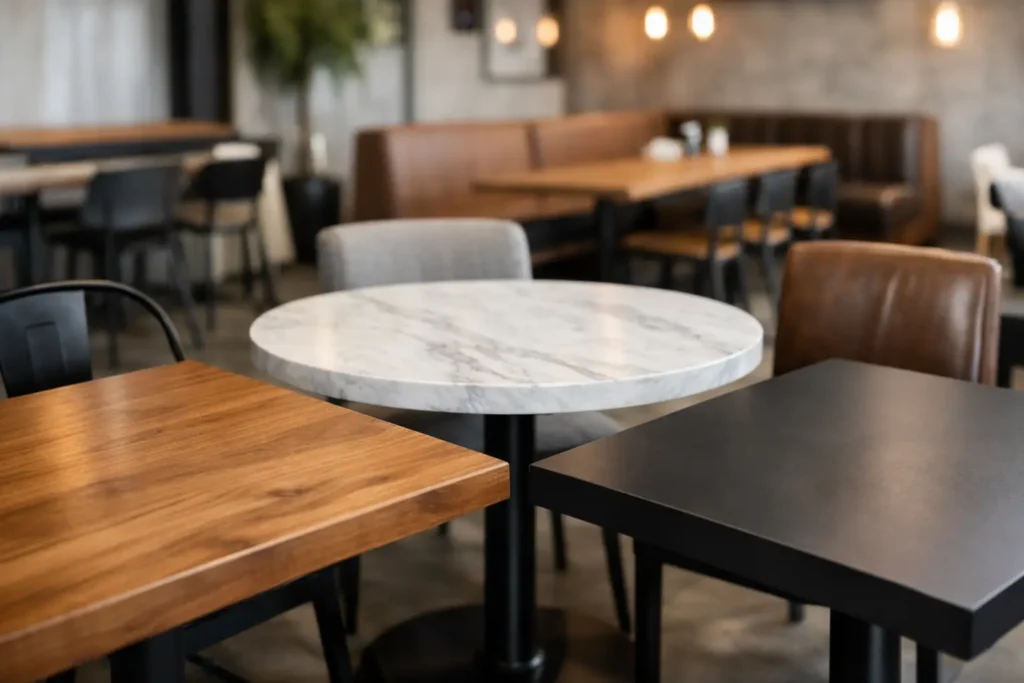
A dining table that looks right on a mood board can fail fast on the floor. In a restaurant, hotel lounge, staff cafe, or club dining room, the wrong table size slows circulation, the wrong finish shows wear too quickly, and the wrong base creates daily frustration for guests and staff. That is why knowing how to choose commercial dining tables is less about picking a nice design and more about specifying a table that performs under real operating conditions.
For commercial buyers, the table is never an isolated piece. It has to work with seating, traffic flow, cleaning routines, brand positioning, and project budget at the same time. A table that suits an upscale dining concept may be completely wrong for a healthcare cafe or education campus setting. The best specification comes from balancing appearance with practical use, not treating one as more important than the other.
How to choose commercial dining tables for the space
Start with the operating model of the venue. A fast-paced F&B environment needs different table priorities than a private club or hotel all-day dining area. In high-turnover spaces, stable bases, easy-clean surfaces, and flexible table sizes usually matter more than highly delicate details. In slower, experience-led environments, material richness and visual presence may carry more weight, provided the construction still meets commercial demands.
The room layout should shape your decision early. Buyers often begin with tabletop finishes, but footprint is the smarter first filter. You need to understand how many covers the space must support, how tables will be combined or separated, and how much clearance servers and guests need. A table that looks compact in a showroom can become oversized once chairs are pulled out and circulation paths are tested.
Table shape is part of that planning. Square and rectangular tops are efficient for maximizing seating count and aligning with walls or banquettes. Round tops soften the room and improve conversation, which makes them useful in hospitality and club settings where guest experience matters. The trade-off is that round tables can reduce layout efficiency in tighter plans. There is no universal best option – only the option that fits the service pattern and floor plate.
Size, seating, and circulation come first
Commercial dining tables should be chosen with realistic seating expectations, not optimistic ones. A two-seater that is too tight becomes uncomfortable, and a four-seater that barely fits place settings will hurt the guest experience. At the same time, oversizing every table reduces total capacity and affects revenue potential in hospitality settings.
Think through everyday use, not just peak occupancy. Will guests arrive mostly in pairs, or do larger groups need to be accommodated quickly? Will tables need to be pushed together without awkward gaps? In business dining areas and staff pantries, are people dining with trays, laptops, or paperwork as well as food? These usage details change the ideal tabletop dimensions.
Base placement is just as important as top size. A beautiful pedestal base can improve legroom, but only if it is weighted correctly and matched to the top dimensions. Four-leg tables can feel familiar and visually lighter, yet poor leg positioning often causes chair clashes at the corners. In commercial projects, stability should always be tested against actual seating layouts rather than judged from appearance alone.
Material selection should match wear levels
One of the biggest mistakes in choosing commercial tables is specifying residential-style finishes for heavy-use environments. In commercial spaces, surfaces are exposed to repeated cleaning, hot items, spills, abrasion, and constant movement. Materials need to be selected for how they age, not just how they look on day one.
Laminate and compact surfaces are often strong choices for high-traffic dining areas because they are practical, consistent, and easy to maintain. Veneer and solid wood can bring warmth and a more premium expression, but they require the right finish system and realistic maintenance expectations. Stone, sintered stone, and similar hard surfaces can create a more elevated look, though weight, edge vulnerability, and handling requirements must be considered during installation and daily operations.
The right answer depends on brand positioning and maintenance culture. A boutique hospitality venue may accept more material character over time if it supports the intended atmosphere. A corporate canteen, healthcare dining space, or education environment usually benefits from finishes that are straightforward, durable, and easy for teams to keep presentable.
Choose bases and construction for real commercial use
A commercial dining table is only as reliable as its structure. Buyers sometimes focus heavily on the tabletop and overlook what happens underneath, but the base, joinery, and fixings determine long-term performance. In busy venues, tables are dragged, leaned on, reconfigured, and cleaned repeatedly. Weak connections show up quickly.
Look for construction suited to the demands of business environments. That includes stable base engineering, durable edge detailing, and materials that can withstand repeated use without loosening or warping prematurely. Knock-down designs can be useful for transport and project logistics, but they must still feel solid once installed.
This is where working with an experienced project supplier makes a difference. A trusted commercial furniture supplier can advise whether a table design is suitable for the intended sector, whether the selected top-to-base combination is structurally sound, and whether there are smarter alternatives that achieve the same design direction with better value or performance.
Design consistency matters more than a single hero piece
In commercial interiors, tables should support a wider visual system. They need to sit comfortably with dining chairs, lounge seating, barstools, outdoor pieces, or adjacent meeting furniture depending on the project. A table may look attractive on its own but still be the wrong choice if it disrupts the overall specification.
That is why many professional buyers shortlist from coordinated collections or style-led ranges. It makes it easier to maintain consistency in material language, proportions, and detailing across the space. This matters in hospitality especially, where guests notice whether the furniture story feels intentional.
If the project spans several zones, consider where variation is useful and where continuity is more valuable. A restaurant may use different table sizes for flexibility while keeping one finish and base family throughout. A hotel can differentiate cafe, lounge, and private dining areas while still maintaining a cohesive design language. VCUS supports this kind of commercial planning with a curated range that helps specifiers build complete, style-consistent environments without overcomplicating the sourcing process.
Budget planning should account for lifecycle value
Price matters in every project, but the cheapest table is rarely the most cost-effective choice. Commercial buyers need to evaluate unit cost against durability, maintenance, replacement risk, and visual lifespan. A lower-cost table that needs early replacement or constant touch-ups can become more expensive than a better-built option specified correctly from the start.
This does not mean every project needs premium materials throughout. Often, the smarter move is to allocate budget where performance is most critical and simplify where wear is less intense. For example, a venue might invest in stronger tops and bases for the main dining area while selecting more economical solutions for secondary spaces. Good procurement is not about spending more – it is about spending deliberately.
Lead times and supply reliability should also be part of the budget conversation. A table that fits the design perfectly but creates program risk may not be the right commercial decision. For multi-site or phased projects, consistency of supply becomes even more important. Repeatability, finish matching, and the ability to scale orders can save significant time and cost later.
Customization can solve project-specific problems
Standard sizes work for many spaces, but not all. In commercial projects, customization often helps resolve layout inefficiencies, branding requirements, or operational constraints. Adjusting tabletop dimensions, finishes, edge details, or base colors can improve both function and visual fit without redesigning the whole scheme.
That said, customization should be used with purpose. If every table becomes a special item, procurement and replacement become harder. The best approach is usually controlled customization – enough to suit the project, but standardized enough to protect lead time, pricing, and future consistency.
How to choose commercial dining tables with fewer mistakes
Before approving any final selection, test the specification against actual use. Review seating layouts, sample the finish under project lighting, and check the feel of the base with the intended chairs. Confirm how the surface will be cleaned, how replacements will be handled, and whether the design aligns with the wider furniture package.
This is where experienced buyers protect the project. They do not just ask whether the table looks good. They ask whether it stacks up operationally, aesthetically, and commercially over time. That mindset usually leads to better outcomes than chasing a trend or choosing solely on price.
A well-specified commercial dining table should support the room quietly and confidently for years. If your selection makes the space easier to use, easier to maintain, and more coherent to experience, you are already on the right track.
