
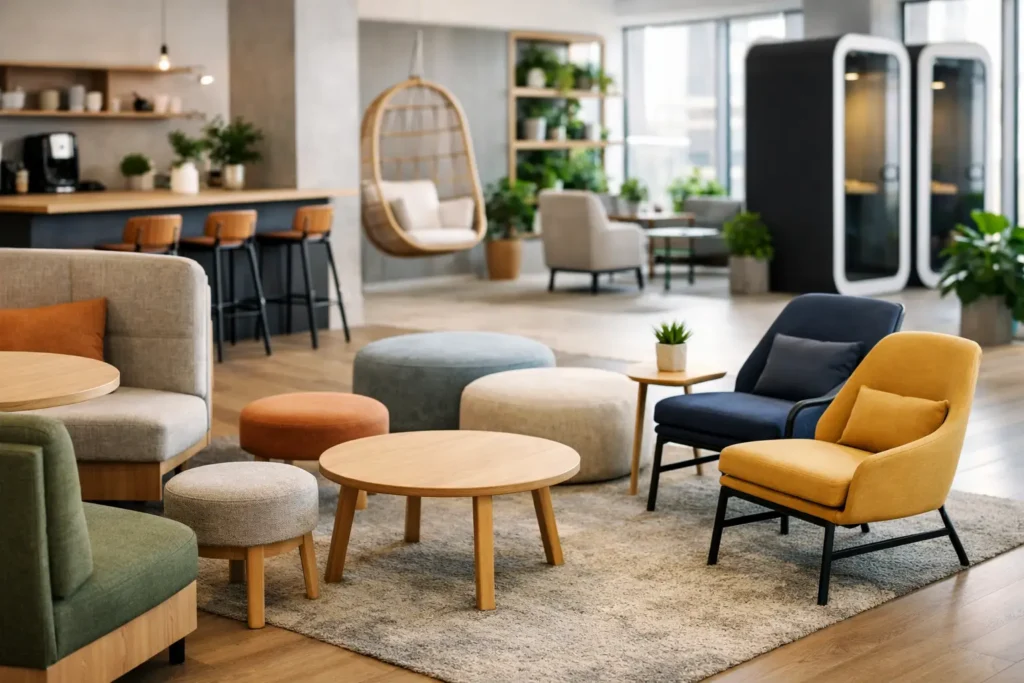
A breakout area that never gets used usually has the same problem – it was furnished like an afterthought. A couple of spare chairs, a small table, and no real reason to stay. The best office breakout area furniture ideas do the opposite. They give people a choice of settings, support different work modes, and make the space feel intentional enough to pull teams away from their desks.
For interior designers, procurement teams, and business owners, that matters because breakout spaces now carry more weight in the office plan. They are where quick catch-ups happen, where staff reset between focused tasks, and where visitors form first impressions of company culture. The furniture has to do more than look current. It needs to hold up to commercial use, support circulation, and fit the broader design language of the workplace.
Office breakout area furniture ideas that work in practice
The strongest breakout areas are rarely built around a single furniture type. They combine soft seating, tables, and flexible pieces in a way that gives people options without creating visual noise. That balance is what separates a polished commercial fit-out from a space that looks pieced together.
1. Modular sofas for flexible layouts
Modular seating is one of the most dependable choices for breakout zones because it can adapt as workplace needs shift. A straight sofa works for a static lounge corner, but modular sections give much more freedom. You can create L-shapes for team huddles, U-shapes for informal meetings, or smaller clusters that make a large floor plate feel more human.
From a project standpoint, modular sofas also help with future-proofing. If the tenant expands, restacks departments, or repurposes a social area into a client lounge, the same pieces can often be reconfigured rather than replaced. That keeps the furniture investment practical, especially for larger offices where layout adjustments are common.
2. Lounge chairs that create individual choice
Not everyone wants to sit shoulder to shoulder on a sofa. Lounge chairs introduce privacy, visual layering, and a more tailored hospitality feel. They work particularly well when paired with compact side tables so users can set down a coffee, a laptop, or meeting notes without needing a full workstation.
The trade-off is footprint. Oversized lounge chairs can quickly consume valuable space, so scale matters. In compact breakout zones, a tighter contemporary armchair often performs better than a deep residential-style piece. Commercial buyers should look closely at seat height, back support, and upholstery durability, not just silhouette.
3. Café tables for quick conversations and short stays
A breakout area should not force every interaction into a lounge setting. Café-height or standard-height small tables give teams a place for short conversations, impromptu one-to-ones, and casual solo work. They also help staff who want a less relaxed posture than sofa seating provides.
Round tables are often the safest choice because they soften circulation and reduce the visual rigidity that can make a social space feel like an overflow meeting room. Square and rectangular tops can be useful too, especially if the area needs to support laptop use, but they require more careful planning around clearances.
4. High tables and bar seating for energy
If the goal is movement, quick exchange, and a more active atmosphere, high tables with barstools or counter stools can shift the tone immediately. These settings are useful near pantry zones, touchdown spaces, and open collaboration areas where people are unlikely to stay for long periods.
This is one of the more effective office breakout area furniture ideas for younger teams and agile workplaces, but it depends on user mix. High seating is not universally comfortable or accessible for every employee or visitor. In most commercial environments, it works best as part of a broader furniture mix rather than the dominant setting.
Designing for more than one behavior
The mistake many projects make is assuming breakout furniture only needs to support relaxation. In reality, these spaces handle several functions across the day. A well-planned furniture scheme considers that overlap from the start.
5. Acoustic booths and high-back seating for privacy
Open breakout areas encourage interaction, but they can also create distractions. Acoustic booths, privacy pods, and high-back sofas help solve that problem without forcing users into enclosed meeting rooms. They are especially effective in offices where breakout spaces sit adjacent to open-plan workstations.
High-back seating can define a semi-private zone for video calls, focused conversations, or small team check-ins. Booth seating with an integrated table can support more task-based use. The specification decision comes down to how much acoustic control is needed and whether the breakout area is expected to absorb some meeting room demand.
6. Bench seating for efficient social zones
Bench seating is often overlooked, yet it can be a very efficient way to furnish breakout and pantry spaces. Fixed or freestanding benches maximize seating capacity while keeping the plan visually neat. They are useful along walls, glazing lines, or perimeter zones where loose furniture might feel cluttered.
The main advantage is space efficiency. The limitation is flexibility. Benches are less adaptable than loose chairs, so they suit projects where the function of the area is clear and stable. Adding upholstered seat pads or paired loose chairs can keep the look from becoming too utilitarian.
7. Mobile pieces that support reconfiguration
Commercial interiors increasingly need to work harder with the same square footage. Mobile ottomans, nesting tables, and lightweight occasional seating make a breakout area more responsive without introducing operational complexity. A team can pull pieces together for a brainstorming session, then return the space to a casual lounge setting within minutes.
This is particularly useful in multipurpose office environments where event use, staff gatherings, and informal collaboration all happen in shared zones. The key is to choose mobile furniture that still looks substantial enough for a permanent fit-out. If the pieces appear temporary or lightweight in a negative way, the area can lose credibility fast.
Materials and finishes matter as much as form
Good concepts fail when the material selection does not match commercial reality. Breakout spaces see high traffic, food and drink use, frequent cleaning, and inconsistent user behavior. Furniture that looks impressive on a mood board can perform poorly if it is not specified for heavy use.
8. Performance upholstery and easy-care surfaces
Textured fabrics, faux leather, laminate, compact surfaces, and powder-coated metal all have a place in breakout environments, but the right mix depends on the setting. A client-facing lounge may call for a richer upholstery story. A staff pantry breakout area may need materials that are faster to maintain and more forgiving under daily wear.
Color also deserves a practical lens. Very light finishes can create a refined look, but they may require a higher maintenance commitment than some operators expect. Darker tones are more forgiving, though too much dark furniture can flatten the space. The best schemes usually blend visual warmth with maintenance discipline.
9. Mixed seating heights for comfort and inclusivity
A polished breakout area gives people options in posture and height. Lounge seating, standard chairs, and higher perching settings each support different behaviors. That variety makes the space more usable across departments, age groups, and working styles.
It also helps with accessibility and comfort. Not every user wants to sink into a low sofa, and not every meeting works around a coffee table. Mixing heights creates a more inclusive environment while making the space feel professionally resolved rather than one-note.
Cohesion is what makes the space feel premium
Furniture selection should not stop at individual pieces. The most successful breakout spaces look connected to the rest of the project. That means aligning forms, finishes, upholstery tones, and table details with the wider office palette.
10. Coordinated collections for a complete look
Using coordinated furniture collections can simplify specification and improve the final result. A matching family of lounge chairs, sofas, stools, and tables creates visual consistency without making the space feel repetitive. This is especially valuable for larger projects where multiple breakout zones need their own identity while still belonging to the same overall design system.
For designers and procurement teams, coordinated collections also reduce sourcing friction. It is easier to control lead times, finishes, and quality expectations when furniture categories are selected with compatibility in mind. That is one reason many commercial buyers work with project-focused suppliers such as VCUS, where product range, customization, and cohesive selection support the full fit-out process rather than a single purchase.
How to choose the right breakout furniture mix
The right answer depends on how the space is actually used. A headquarters reception lounge will need a more polished front-of-house mix, while an internal staff breakout zone may prioritize durability, flexibility, and seat count. A compact office may rely on furniture that supports both socializing and light work, while a larger floor plate can afford more specialized settings.
Budget matters too, but value is not the same as buying the lowest-cost piece. In commercial projects, replacement, maintenance, and mismatch across categories can be more expensive than specifying correctly from the start. A well-balanced breakout area usually comes from choosing fewer, better-considered furniture types and ensuring each one serves a clear purpose.
The best breakout spaces feel easy because the planning behind them was disciplined. When the furniture mix is right, the area starts working immediately – for collaboration, pause moments, casual meetings, and the everyday experience of being in the office. That is the benchmark worth aiming for in any modern workplace project.
