
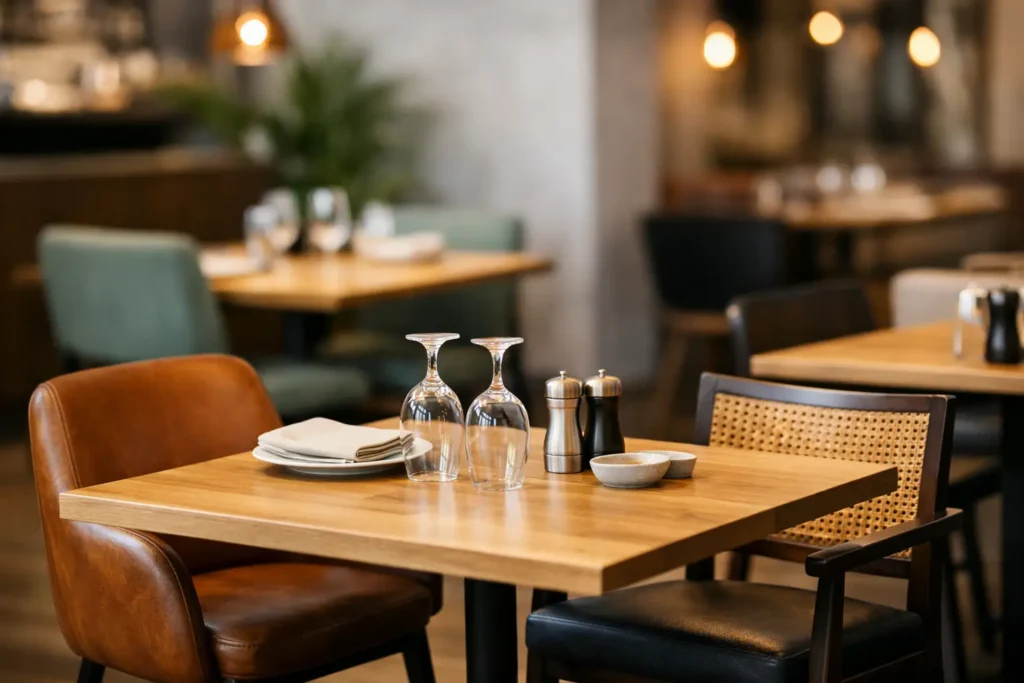
A restaurant can get the menu right, the lighting right, and the floor plan right – then lose the room with furniture that feels pieced together. Guests may not describe the problem in technical terms, but they notice when table heights are off, chair proportions feel awkward, or finishes clash across the dining area. For operators, designers, and fit-out teams, matching chairs and tables for restaurants is not a styling exercise alone. It affects comfort, traffic flow, cleaning efficiency, brand perception, and long-term replacement cost.
The right match creates a dining environment that feels considered from the first impression to the last seat turned at closing. The wrong match creates friction everywhere.
What matching chairs and tables for restaurants really means
In commercial projects, “matching” does not always mean identical materials, colors, or silhouettes. In fact, a full set of perfectly uniform pieces can sometimes make a restaurant feel flat or too generic. A better goal is coordinated compatibility.
That means chairs and tables should work together in proportion, finish, function, and visual language. A slim contemporary table base may pair well with upholstered dining chairs if the seat profile stays light. A solid wood tabletop may work with powder-coated metal chairs if the finish palette is controlled and the overall concept remains consistent.
Professional buyers usually get the best results when they assess furniture as a collection rather than as separate line items. This is especially true in hospitality projects, where the guest experience depends on how every element reads together across the space.
Start with the dining concept, not the chair
One of the most common specification mistakes is selecting a chair because it looks strong on its own, then trying to build the table program around it. In restaurants, the sequence should usually run the other way. Start with the dining concept, service style, and customer turnover model.
A quick-service concept has different furniture needs than an all-day cafe, a fine dining room, or a hotel restaurant. If tables need to be moved frequently to accommodate changing group sizes, weight and stackability become more important. If the venue is positioned as premium, tactile finishes and seating comfort may take priority over dense seat counts.
Once the concept is clear, furniture decisions become easier. A compact urban cafe may call for smaller tabletops, lighter visual profiles, and chairs that tuck in neatly. A destination dining venue may justify broader tables, more expressive chair forms, and mixed seating types such as dining chairs, banquettes, and barstools.
Proportion is where good restaurant furniture sets itself apart
If there is one factor that separates a polished restaurant fit-out from an average one, it is proportion. Chairs and tables can come from the same collection and still feel wrong together if dimensions are not properly aligned.
Seat height and tabletop height need to work as a pair. Standard dining tables and chairs often fit within familiar commercial ranges, but minor differences matter. If the chair seat is too high relative to the tabletop apron, guests feel cramped. If the chair is too low, the dining posture becomes awkward and the space feels less refined.
Width matters too. A generously scaled chair with arms may look impressive in a showroom, but it can reduce seating capacity at two-top or four-top layouts. Armless chairs may improve density, yet they are not always the right choice for higher-end settings where comfort and dwell time matter. There is always a trade-off between operational efficiency and seating generosity.
Table base placement is another detail that affects the match. A beautiful chair is no use if guests are constantly negotiating around pedestal bases or table legs. In project settings, these functional dimensions should be checked before finalizing finishes.
Materials should match the workload, not just the mood board
Restaurant furniture takes daily punishment. Matching chairs and tables for restaurants has to account for cleaning routines, spill exposure, movement, abrasion, and uneven wear across peak-service zones.
Wood-look finishes may suit warm hospitality concepts, but not every wood finish performs the same way under commercial use. Solid timber can age beautifully, though it may require more maintenance and show impact marks. Laminate, veneer, sintered stone, compact surfaces, and powder-coated metal can offer a more controlled balance of aesthetics, durability, and cost depending on the project.
The chair material should be judged with the same discipline. Upholstered seats can elevate comfort and acoustics, but they also require the right fabric or faux leather specification for stain resistance and cleaning. Fully molded plastic or metal chairs may simplify maintenance, though they can feel less premium unless the design language is handled carefully.
This is where a coordinated sourcing approach helps. Buyers who specify across categories with one trusted commercial furniture supplier can assess finish harmony and performance requirements together instead of patching solutions from multiple vendors.
Matching does not mean one-note
Some of the strongest restaurant interiors use controlled variation. You might specify one dining chair for the main floor, barstools in a related finish for the counter, and a complementary table program that ties both zones together. The result feels cohesive without looking repetitive.
The key is to repeat enough elements to create visual order. That may be a consistent timber tone, a shared metal finish, similar edge detailing, or a family resemblance in curves and lines. Once those anchors are in place, variation can add depth.
For example, a hospitality venue may combine square and round tables to improve planning flexibility while keeping the same tabletop finish and base style. It may also use side chairs for standard dining and armchairs only at feature tables or perimeter seating. These decisions support both design and operations.
Budget control gets easier when the specification is more disciplined
Restaurant projects rarely have unlimited furniture budgets. Matching well does not mean choosing the most expensive pieces. It means making sure the specification works as a whole, with spending directed where it delivers visible and practical value.
In many projects, it makes sense to invest more in high-contact items such as dining chairs, then control costs through smart tabletop and base combinations. In other cases, the tables carry more visual weight, especially in design-led venues where surface finish becomes a major part of the identity.
The important point is consistency. A mismatched scheme often leads to expensive corrections later – replacement chairs that do not fit under tables, finishes that age differently, or ad hoc purchases made when original items are no longer available. Project buyers benefit from working with suppliers that can support repeat orders, coordinated collections, and customization when required.
Think beyond the opening day
Restaurant furniture should still look credible after months of service, not just during handover photography. That means planning for replacement cycles, spare quantities, and availability across the collection.
This is particularly important for operators expanding across multiple outlets or hospitality groups standardizing brand presentation. A chair and table pairing that works today should be supportable later, whether for an additional location, a partial refresh, or a damaged-item replacement.
It also helps to think about how the furniture will perform during layout changes. Can tables be reconfigured without exposing mismatched heights or finishes? Can chairs move between zones without looking accidental? Flexibility has value, especially in restaurants that host events or adapt seating plans around seasonal demand.
Why showroom evaluation still matters
Screens are useful, but restaurant furniture is a physical decision. Proportions, textures, seat comfort, edge profiles, and finish tones often read differently in person. A chair that looks elegant online may feel too narrow in use. A tabletop finish that appears warm on screen may turn cooler under project lighting.
That is why showroom-based selection remains valuable for commercial buyers. It allows designers, owners, and procurement teams to review coordinated options side by side and make faster decisions with fewer surprises later. For project-driven sourcing, that hands-on process can save time and protect specification quality.
For teams furnishing hospitality spaces at scale, working with a project-oriented partner such as VCUS can simplify this process. It brings chairs, tables, bar seating, lounge pieces, and customization options into one coordinated conversation, helping buyers create stylish and functional environments without losing control of budget or delivery.
The best match supports both brand and operations
Furniture selection in restaurants sits at the intersection of design intent and daily use. A beautiful match that slows service or wears poorly is not a strong commercial decision. A purely practical match that weakens the brand experience is not the right answer either.
The most successful restaurant projects treat chairs and tables as part of a larger operating system. They support the guest journey, reinforce the concept, fit the floor plan, and remain durable under real commercial pressure. When those pieces line up, the space feels settled, confident, and ready for business.
If you are specifying furniture for a new restaurant or refurbishment, the smartest place to start is not with what looks good alone. It is with what works well together – on the floor, on the budget, and over the life of the project.
