
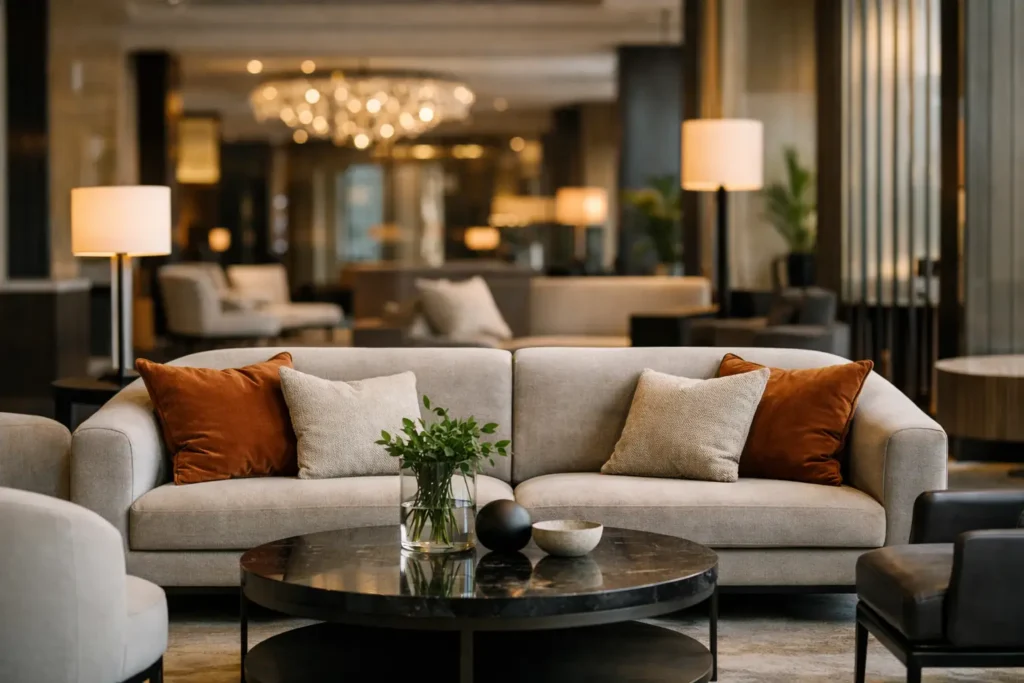
A hotel lobby sofa starts working before anyone sits down. It signals the level of the property, shapes the first impression, and quietly manages heavy daily use from check-ins, waiting guests, informal meetings, and late-night lounging. That is why choosing the best hotel lobby sofas is not just a styling exercise. It is a specification decision that affects guest experience, maintenance costs, and the overall credibility of the interior.
For hospitality buyers, designers, and project teams, the right sofa needs to do several jobs at once. It should look refined, support the concept of the property, hold up under constant traffic, and fit within a project budget that still leaves room for the rest of the lobby scheme. The best results usually come from balancing visual impact with practical performance rather than over-prioritizing one or the other.
What makes the best hotel lobby sofas
The best hotel lobby sofas are rarely the softest or the most sculptural piece on the floor. In commercial settings, good specification is about proportion, durability, flexibility, and how well the sofa works with the full furniture plan.
Seat depth is one of the first decisions to get right. A deep, lounge-style sofa can create a relaxed boutique feel, but it may not suit business hotels where guests want to sit upright while checking phones or having short conversations. A more moderate seat depth is often the safer choice for mixed-use lobbies because it accommodates a wider range of body types and guest behaviors.
Seat height matters just as much. If the sofa sits too low, it can look elegant in photos but feel awkward for older guests or anyone getting up with luggage in hand. Commercial hospitality seating should feel easy to use. That usually means a comfortable height, supportive foam, and a back angle that encourages lingering without becoming overly casual.
The frame and internal construction are where long-term value shows up. A lobby sofa may be used from morning until midnight, every day, by guests who have no reason to treat it gently. Commercial-grade joinery, high-density cushioning, and stable leg construction are essential. Residential-style sofas may look similar at first glance, but they often break down faster in hospitality environments.
Matching the sofa to the hotel type
Not every property needs the same answer, which is why there is no single winner among the best hotel lobby sofas. The right choice depends on brand positioning, guest profile, and the operational rhythm of the space.
In upscale business hotels, clean-lined contemporary sofas tend to perform well because they communicate professionalism and keep the lobby visually organized. Guests are often moving through quickly, holding short meetings, or waiting between appointments. In that setting, structured silhouettes and tailored upholstery usually make more sense than oversized residential forms.
Boutique hotels often have more room to make a statement. Curved sofas, textured upholstery, and distinctive detailing can help the lobby feel memorable and design-led. The trade-off is that highly specific forms can be harder to reconfigure later, and unusual upholstery may require more careful maintenance planning.
Resort and lifestyle properties usually benefit from softer, more relaxed seating compositions. Modular sofas work especially well here because they can create social clusters and larger lounge zones without making the lobby feel rigid. That said, modular pieces need disciplined space planning. If the layout becomes too loose, circulation suffers and the reception area can feel less controlled.
Sofa styles that work best in hotel lobbies
Straight sofas remain one of the most dependable choices for hospitality projects. They are easy to place, easier to pair with lounge chairs and coffee tables, and often the most efficient option for maintaining clean traffic paths. For many midscale and upscale hotels, this is still the most versatile format.
Curved sofas are increasingly popular in modern hospitality interiors because they soften the architecture and add a more premium, custom feel. They are especially effective in larger lobbies where you want to break up hard lines or create a central feature. The downside is planning complexity. Curved pieces demand more floor area and need the surrounding furniture to be scaled carefully.
Modular sofas are a strong fit for hotels that want flexibility. They can be configured into long runs, corner compositions, or island seating depending on the zone. For project buyers, this format can simplify specification across multiple areas of the lobby. It also supports phased refreshes, since individual modules may be replaced or updated without removing an entire installation.
Compact two-seaters and apartment-scale sofas are useful in smaller lobby footprints or secondary waiting areas. They give designers more control over zoning and spacing, especially when paired with occasional chairs. In tighter layouts, several smaller sofas often work better than one oversized statement piece.
Upholstery and finishes: where hospitality projects succeed or fail
A well-designed sofa can still become the wrong choice if the upholstery is not suited to the property. Material selection should reflect traffic level, cleaning protocols, climate, and the guest experience the hotel wants to create.
Performance fabric is often the most balanced option for hotel lobbies. It offers warmth, visual texture, and a broad palette while remaining easier to maintain than many decorative textiles. For many properties, this is the safest route because it supports both design flexibility and operational practicality.
Faux leather and high-quality commercial vinyl can work well in high-traffic environments where wipe-clean performance is a priority. These finishes are useful in busy city hotels, transit-adjacent properties, and mixed-use hospitality settings. The trade-off is comfort perception. If the material feels too cold or too hard-edged, the lobby may lose some of its welcome.
Boucle, velvet-look textures, and other tactile fabrics can be attractive for boutique and luxury concepts, but they need to be specified carefully. Some are better used as accents rather than across every major seating piece. The more distinctive the textile, the more important it is to think ahead about wear patterns, stain visibility, and replacement consistency.
Color is another commercial decision, not just a decorative one. Very light upholstery can look impressive on opening day but may require more maintenance than the operations team wants to manage. Very dark finishes can hide stains but sometimes make a lobby feel heavier than intended. Mid-tone neutrals, warm earth shades, and layered textured fabrics often deliver the best balance of style and resilience.
How to evaluate best hotel lobby sofas for a real project
Procurement teams and designers should assess sofas in the context of the full lobby, not as isolated hero pieces. A sofa that looks strong in a catalog may fail once reception counters, luggage movement, lighting, and circulation are introduced.
Start with zoning. If the lobby needs to support waiting, social interaction, laptop use, and quick meetings, one sofa type may not be enough. A combination of formal and relaxed seating often performs better than forcing one format to handle every activity.
Then review scale. Oversized sofas can make a large lobby feel luxurious, but in many projects they reduce flexibility and create dead space around them. On the other hand, pieces that are too small can make the property feel under-furnished or value-engineered in the wrong way. Commercial interiors work best when the seating proportion feels intentional.
Sample review is also critical. Buyers should assess comfort, upholstery hand feel, stitching quality, leg stability, and how the sofa reads from multiple angles. In hospitality, guests approach furniture from all sides, not just from the front. A piece that looks excellent in elevation but unresolved at the back can weaken the whole space.
This is also where a project-focused supplier adds real value. When furniture is being selected as part of a wider hospitality scheme, it helps to work with a partner that can coordinate matching lounge chairs, occasional tables, bar seating, and other public area pieces in a consistent design language. For professional buyers, that saves time and reduces specification friction across the project.
Budget, lead time, and customization
The best hotel lobby sofas are not always the most expensive. In many successful projects, value comes from choosing pieces with strong commercial construction, practical upholstery options, and a style that will still look current several years from now.
Customization can be worth it when the property needs a distinctive identity or has unusual space constraints. Adjustments to upholstery, dimensions, or leg finishes can help a standard sofa fit a more tailored concept. But customization should be used with discipline. Bespoke changes can affect lead times, minimum quantities, and future replacement planning.
For that reason, experienced hospitality buyers usually look for a middle ground: designer-led commercial sofas with enough flexibility to support the concept, but with reliable production and repeatability behind them. That is often the smarter long-term decision than chasing a one-off look that becomes difficult to maintain.
A supplier such as VCUS is typically most valuable in this stage of the process, where style consistency, project pricing, and dependable coordination matter as much as the sofa itself. For hotels furnishing multiple zones at once, that kind of support can keep the entire specification more cohesive and more manageable.
A better question than which sofa is best
The better question is which sofa is best for this hotel, this lobby, and this operating model. Some properties need statement curves and tactile fabrics. Others need structured seating that handles constant turnover without losing its shape. The strongest hospitality interiors are built on that level of clarity.
When a lobby sofa gets the balance right, guests may never think about why the space feels so comfortable and well put together. They simply feel it. That is usually the mark of a good commercial furniture decision.
