
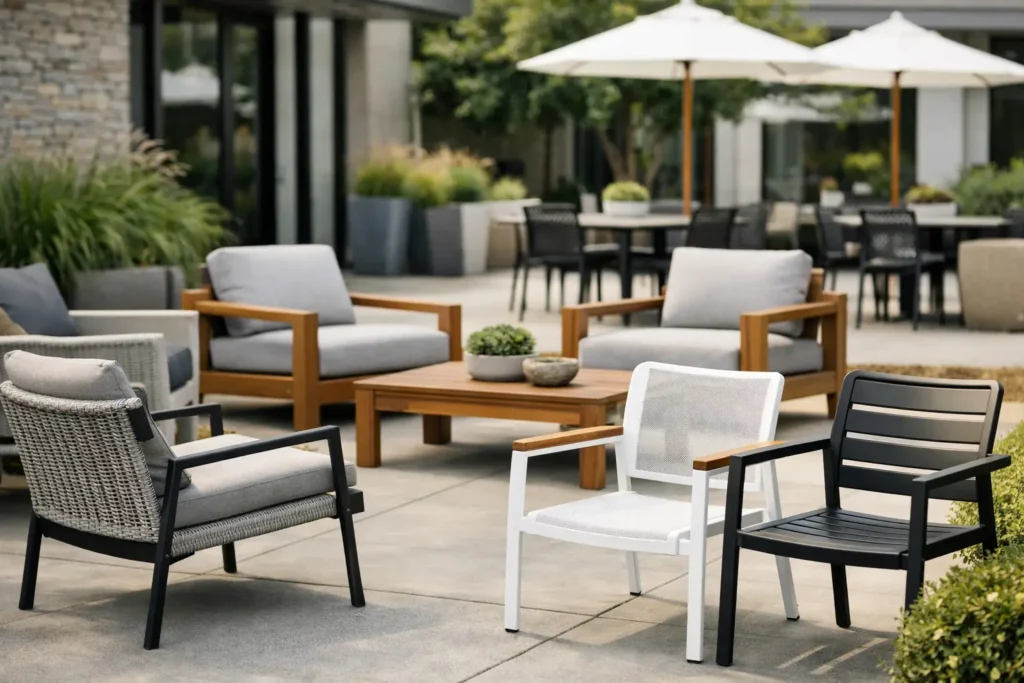
A chair that looks great on opening day can become a maintenance problem by the end of the season. In commercial outdoor settings, that gap matters. The best commercial outdoor chairs need to do more than suit a design concept – they need to handle weather, turnover, cleaning routines, storage demands, and daily use without dragging down the overall look of the space.
For designers, procurement teams, and business owners, outdoor seating is rarely a standalone purchase. It sits inside a bigger specification decision involving tables, bar seating, lounge pieces, and circulation planning. That is why the right choice is not simply the most stylish chair or the lowest-cost option. It is the chair that performs reliably in your environment, aligns with the rest of the project, and holds up well enough to protect your budget over time.
What makes the best commercial outdoor chairs
The strongest commercial options balance four things at once: durability, comfort, visual consistency, and operational practicality. If one of these is missing, the chair often becomes a compromise that shows up later in complaints, replacements, or an inconsistent finished space.
Durability starts with material honesty. Outdoor furniture for hospitality terraces, poolside zones, office breakout areas, and F&B settings faces sun, rain, humidity, spills, and frequent movement. Powder-coated aluminum, treated steel, quality polypropylene, synthetic wicker, and outdoor-rated upholstery all have a place, but the best choice depends on the project. Aluminum is favored for its corrosion resistance and lighter weight. Polypropylene works well for high-turnover venues that need easy cleaning and stackability. Synthetic woven designs can bring warmth and texture, especially in hospitality, but quality matters because low-grade weaves tend to age poorly.
Comfort is often undervalued during procurement because it is harder to measure than dimensions or unit cost. Yet in commercial spaces, comfort affects dwell time, customer satisfaction, and how a place is perceived. A cafe chair that encourages short visits may be useful in one concept and completely wrong for a hotel terrace or club lounge. Seat depth, back angle, armrest height, and material temperature in direct sun all influence how usable the chair really is.
Visual consistency matters because outdoor areas are now expected to feel like a continuation of the interior brand experience. Buyers increasingly want furniture that supports a cohesive look across dining, lounge, and waiting zones. A chair can be highly practical and still fail the project if it clashes with the broader design language.
Operational practicality is where many purchasing decisions become clear. Can the chairs stack? Are they heavy enough to feel substantial but light enough for staff to move? Will they dry quickly after rain? Do they require special care? The best commercial outdoor chairs support the day-to-day realities of the venue, not just the mood board.
Choosing by use case, not just appearance
A rooftop bar, a healthcare garden, and an office terrace may all need outdoor chairs, but they do not need the same chair. This is where commercial buyers benefit from a project-led approach rather than a purely retail mindset.
For hospitality dining, chairs need to strike a careful balance between comfort and table efficiency. You want a seat that feels inviting without becoming bulky or hard to arrange. Armchairs can elevate the look and improve comfort, but they take up more footprint and reduce table flexibility. Side chairs often make layout planning easier, particularly in compact dining zones.
For cafes and fast-paced F&B venues, lighter stackable chairs are often the better long-term choice. They simplify cleaning, reset faster, and usually offer better replacement planning if volumes are high. The trade-off is that ultra-light chairs can sometimes feel less premium, so the finish and silhouette need to carry the design value.
For hotel poolsides and resort-style terraces, the seating mix usually matters more than any single item. Dining chairs, lounge chairs, and occasional seating need to work together visually. Here, texture and comfort often carry more weight, but materials must still perform under heavy sun exposure and moisture.
For corporate outdoor spaces, the brief tends to be different. Businesses often want outdoor areas that feel polished and contemporary while staying low maintenance. This usually favors clean-lined aluminum or molded designs that support a professional aesthetic and can coordinate easily with matching tables, benches, or lounge pieces.
For healthcare and education environments, practical factors rise to the top. Ease of cleaning, stability, safety, and straightforward maintenance often outweigh highly decorative detailing. That does not mean the furniture has to feel institutional. It means the best specification is one that keeps visual warmth while meeting the functional reality of the site.
The materials question: what actually holds up
When buyers ask for the best commercial outdoor chairs, they are often really asking which materials will create the fewest problems later.
Aluminum remains one of the safest commercial choices. It resists rust, suits contemporary settings, and can work across dining and lounge applications. It is especially useful where teams need to move furniture regularly. The main consideration is finish quality. Poor powder coating chips and fades faster, which quickly undermines the visual standard of the space.
Outdoor-rated polypropylene has become a strong option for many commercial projects because it combines durability, easy maintenance, and cost efficiency. It also allows for a wide range of forms, from minimal cafe seating to more sculptural pieces. The limitation is that not every polypropylene chair looks premium enough for higher-end hospitality, so design selection matters.
Steel can be effective, particularly when a heavier feel is desirable, but it requires more caution in exposed environments. If the finish is compromised, corrosion becomes a risk. In covered outdoor settings, it may still be a sound choice.
Synthetic wicker and woven rope styles bring a softer, more residential character that works well in hospitality and club environments. These materials can be excellent when properly manufactured for commercial use. The trade-off is that they often require more careful evaluation, because quality varies significantly across suppliers.
Outdoor upholstery can improve comfort and elevate the space, but it should be specified with discipline. In uncovered areas, removable cushions and quick-dry foams usually make more operational sense than heavily upholstered chairs. In covered settings, upholstered seating can be a smart upgrade if maintenance protocols are realistic.
Best commercial outdoor chairs also need to fit the project workflow
Good furniture specification is not just about product performance. It is about supply confidence, finish coordination, and project simplicity. That is often where buyers separate a workable choice from the best commercial outdoor chairs for their needs.
If your project includes indoor and outdoor zones, selecting from a supplier with coordinated categories can save significant time. It becomes easier to create continuity across dining chairs, barstools, lounge seating, and tables when the collection is organized with commercial use in mind. For specifiers managing multiple decision points, this matters as much as the chair itself.
Customization can also make a major difference. A standard outdoor chair may be close to right, but not quite there in finish, fabric, or scale. For commercial projects, the ability to adjust colors, materials, or related pieces can help preserve design intent without forcing a complete product change.
Lead time and replacement planning should be discussed early. Outdoor seating often gets approved late in the process, yet it still needs to arrive in time for opening. Buyers should also think beyond delivery. If additional units are needed later, can the range still be sourced consistently? A dependable commercial furniture partner adds value here by reducing risk, not just quoting a price.
How to evaluate a chair before you specify it
Images are helpful, but they are not enough for commercial decision-making. A chair can look refined in a catalog and still feel unstable, uncomfortable, or poorly finished in person. Whenever possible, evaluation should include physical review.
Check how the chair feels when pulled in and out, stacked, and sat on for more than a few minutes. Look at welds, coating consistency, edge finishing, and drainage design. Ask whether glides are suitable for the floor surface. Confirm if the chair is intended for fully exposed use or only partially sheltered outdoor environments.
It is also worth testing the chair as part of a group, not in isolation. One attractive piece does not create a successful terrace. The finished result depends on spacing, table compatibility, and how the seating mix reads across the full layout. This is where showroom-based selection can be especially useful for project teams comparing options side by side.
For buyers furnishing hospitality, office, healthcare, or education spaces, working with an experienced commercial supplier such as VCUS can simplify this process. The advantage is not only product access. It is the ability to shortlist design-forward options that are commercially realistic, budget-conscious, and easier to coordinate across an entire project.
Price matters, but value matters more
Low upfront pricing can be tempting, especially on larger-volume orders. But outdoor chairs that fade early, wobble under heavy use, or need frequent replacement rarely stay cheap. Commercial value comes from performance over time, not just the landed unit cost.
That does not mean the highest-priced chair is automatically the best option. In many projects, a well-made mid-market chair with smart material choices will outperform a more expensive design that is too delicate for the setting. The right question is not Which chair costs less today? It is Which chair protects the design, operations, and replacement budget over the life of the space?
The best commercial outdoor chairs are the ones that keep working after the launch photos are taken. They support the brand image, stand up to use, and make life easier for the teams managing the space every day. If your shortlist does all three, you are not just buying chairs – you are specifying a more reliable outdoor environment.
