
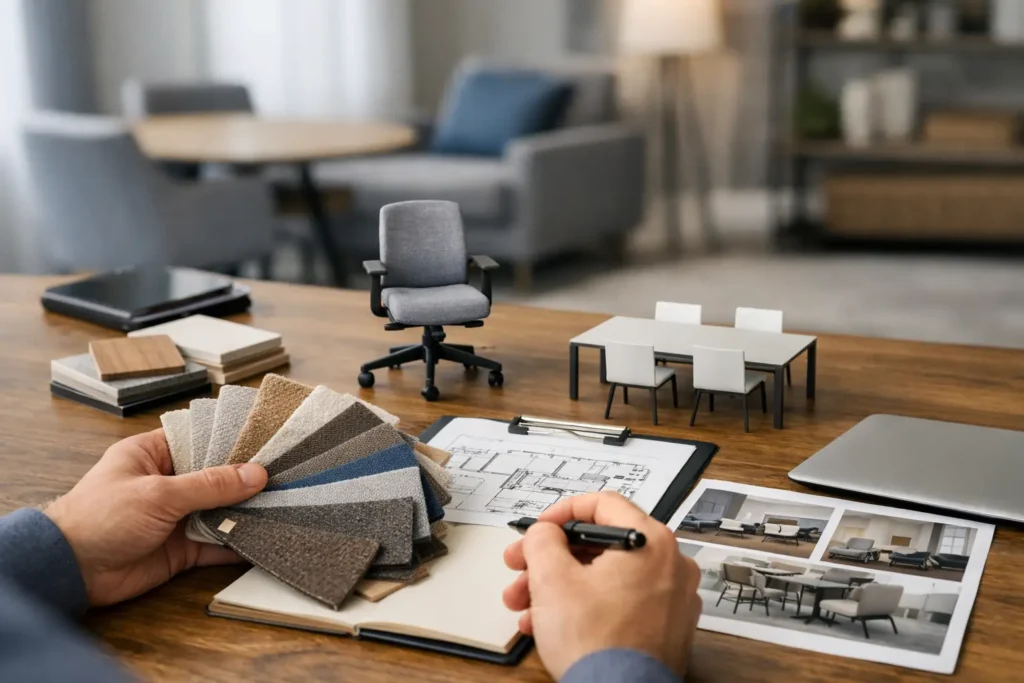
A chair that looks right on a mood board can fail quickly on a live project. The fabric pills, the frame loosens, the dimensions fight the floor plan, or the lead time slips and delays handover. That is why knowing how to specify contract furniture is less about picking attractive pieces and more about making disciplined decisions that hold up under daily commercial use.
For interior designers, architects, procurement teams, and business owners, the specification process sits at the point where design intent meets operational reality. The best result is not simply a beautiful chair, table, or sofa. It is a coordinated furniture package that supports the brand, fits the use case, meets budget, and arrives on time.
How to specify contract furniture from the start
A strong specification begins with the project brief, not the product catalog. Before shortlisting any item, define the space type, expected traffic, user profile, maintenance needs, budget band, and installation timeline. A hospitality lounge, a healthcare waiting area, and a training room may all need seating, but the performance criteria are very different.
This early stage is where many projects either become efficient or expensive. If the brief is vague, teams tend to respecify later, and that usually costs time and money. It is far better to lock in the fundamentals first – where each item will go, who will use it, how often, and what the furniture must withstand over time.
Design intent should also be clarified early. Are you building a warm hospitality feel, a clean executive office, a youthful education space, or a high-turnover F&B environment? When the visual direction is clear, it becomes much easier to create a cohesive specification across chairs, lounge seating, tables, barstools, and outdoor pieces without mixing styles that compete with each other.
Start with function before aesthetics
Commercial buyers rarely have the luxury of specifying on looks alone. Function should lead, because performance problems are far more costly than design revisions.
Seating is a good example. In a meeting room, stackability might matter more than upholstery. In a fine dining setting, comfort over a 90-minute seating cycle may matter more than compact footprint. In an office breakout area, easy-clean surfaces and movable formats may be the real priority. The same logic applies to tables, storage, and system furniture. Every item should be tied to a clear operational purpose.
This does not mean aesthetics come second in a careless way. It means the right aesthetic is the one that works in service of the space. The strongest commercial interiors feel considered because every furniture choice supports the experience people are supposed to have there.
Ask the practical questions early
Before approval, each item should answer a few non-negotiable questions. Is it sized correctly for circulation and accessibility? Is it suitable for the expected frequency of use? Will finishes age well in that environment? Can the client maintain it without special care routines? If the answer is uncertain, the item may still be viable, but it needs closer review.
Match materials to the real environment
Material selection is where commercial furniture specifications either become durable or become a maintenance problem. Timber veneer, laminate, powder-coated metal, molded polypropylene, performance fabric, and commercial-grade leather all have their place. The right choice depends on use conditions, cleaning protocols, and wear patterns.
In hospitality and F&B projects, spills, cleaning chemicals, and constant movement need to be factored in. In healthcare and education, hygiene, impact resistance, and ease of maintenance often carry more weight. In office environments, appearance over time matters just as much as day-one presentation, especially in reception, boardroom, and collaborative spaces.
There is always a trade-off. Softer materials may create a richer guest experience but require more care. Harder surfaces may improve durability but feel less premium. A good specification does not pretend there is one perfect finish for every project. It balances look, lifespan, and maintenance based on the brief.
Think in collections, not isolated pieces
One of the most efficient ways to specify well is to work from coordinated collections rather than sourcing every item independently. In commercial projects, cohesion matters. It affects how a reception area connects to meeting rooms, how a restaurant dining space relates to its bar area, and how a guest lounge complements adjoining outdoor seating.
When products are organized by style and intended use, specifiers can build consistency faster and reduce approval friction. This is especially helpful on projects that need matching language across multiple categories, such as dining chairs, lounge seating, stools, tables, and occasional pieces.
This approach also reduces risk. If each item comes from a completely different source, finish matching, lead time coordination, and quality consistency become harder to manage. A curated project supply model gives buyers more control and fewer surprises.
Budget for total value, not just unit price
The cheapest option is often expensive once replacement cycles, maintenance calls, and project disruption are counted. Contract furniture should be evaluated on total value – purchase price, expected service life, maintenance burden, and suitability for the setting.
A lower-cost chair may be acceptable in a low-traffic back-of-house area but fail in a busy café or waiting zone. A premium upholstery choice may be worth the spend in a flagship reception space but unnecessary in a staff training room. Good specification is rarely about spending more everywhere. It is about spending where performance and visual impact matter most.
This is where experienced project suppliers become useful partners. They can usually suggest where to invest, where to standardize, and where to substitute without weakening the overall result. That protects both the design intent and the budget.
How to specify contract furniture without risking the timeline
Lead time is part of the specification, not a separate procurement problem. A beautiful furniture schedule is not workable if half the products cannot arrive in sync with site readiness.
During selection, check stock status, manufacturing timelines, customization windows, shipping implications, and installation sequencing. Imported products, made-to-order items, and custom finishes can all be excellent choices, but they require realistic planning. If the project has a fixed opening date, flexibility may need to come from finish options or non-critical items rather than core pieces.
Phasing matters too. Some projects can install front-of-house first and complete secondary areas later. Others need full handover at once. The furniture package should be specified with that operational reality in mind.
Customization needs clear limits
Customization can improve fit and brand alignment, but it should be controlled. Changes to upholstery, dimensions, finishes, and details can affect price, compliance, and delivery. If customization is necessary, define exactly what must change and why. Customizing every item without discipline usually creates cost and coordination issues.
Evaluate the supplier as carefully as the product
A specification is only as reliable as the supplier behind it. Commercial buyers need more than a catalog. They need confidence that the vendor can advise, coordinate, and deliver at project level.
Look for a supplier with breadth across categories, a clear understanding of commercial use cases, and the ability to support showroom review, finish coordination, customization, and delivery planning. That matters even more on multi-space projects where consistency is critical.
For many professional buyers, this is the difference between a transactional purchase and a dependable project partnership. A trusted commercial furniture supplier should help simplify selection, flag risks early, and keep the specification aligned with the realities of budget and program. That is one reason firms work with VCUS on offices, hospitality spaces, healthcare environments, education projects, and other commercial interiors that need style, function, and dependable execution.
Build a specification that is easy to approve
The best furniture specification is easy for stakeholders to understand. That means presenting not only what has been selected, but why. Decision-makers respond faster when each item is tied to purpose, finish rationale, durability needs, and cost logic.
Clear schedules, finish boards, dimensions, and application notes help reduce revisions. So does showing consistency across the whole environment. If a client can see how the lounge chair relates to the side chair, the meeting table, and the barstool, approvals tend to move with less hesitation.
This is especially valuable when several parties are involved, such as designers, owners, operators, and procurement teams. A coherent, well-explained package creates confidence that the project is under control.
The goal is furniture that keeps working after handover
A successful specification does not end when the site opens. It should still feel right after months of use, cleaning, movement, and occupancy. That is the real test.
If you are specifying carefully, you are not just choosing products. You are shaping how people work, wait, meet, dine, recover, and move through a space every day. The right furniture does more than complete the design. It protects the experience the space was built to deliver.
