
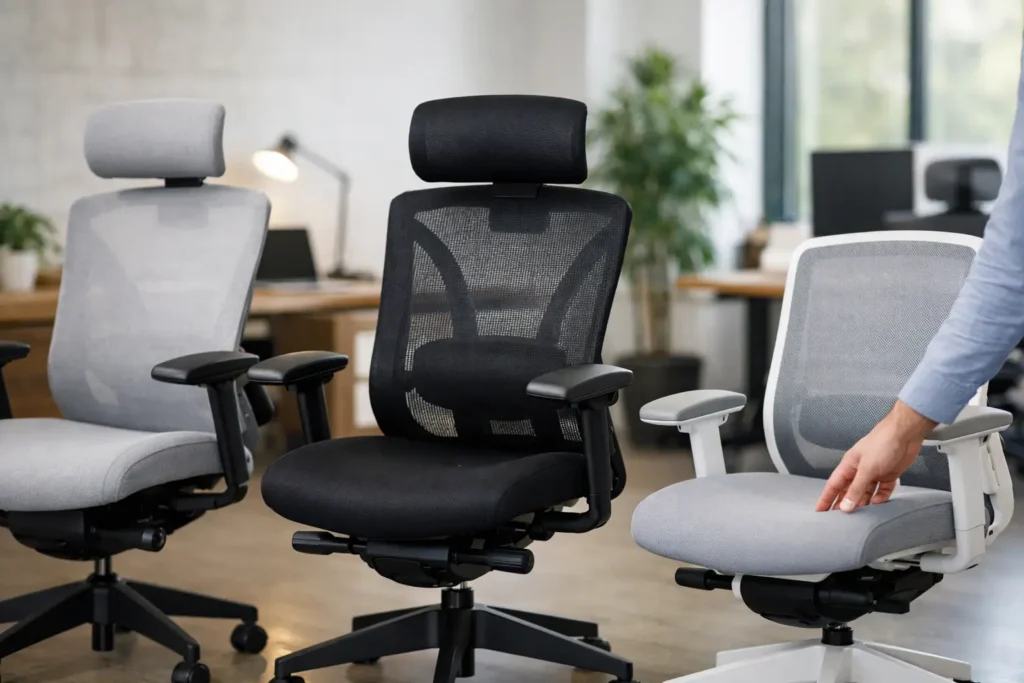
A chair that feels fine during a five-minute showroom test can become a daily complaint once a team sits in it for eight hours. In commercial projects, that gap matters. The wrong office seating does not just affect comfort – it can lead to poor posture, inconsistent user satisfaction, faster wear, and costly replacement cycles.
For designers, procurement teams, and business owners, knowing how to choose ergonomic office chairs means looking beyond surface-level features. The right selection has to support real working patterns, suit the visual direction of the space, hold up under heavy use, and stay within project budget.
How to choose ergonomic office chairs for commercial use
In a workplace setting, ergonomic seating should be specified as part of the broader environment, not as a standalone purchase. A chair may offer multiple adjustments, but if it does not fit the user profile, desk setup, or usage intensity of the space, those features have limited value.
The most reliable way to choose is to assess the chair across four practical areas: user support, adjustability, durability, and design fit. Those factors usually matter more than marketing terms.
A private executive office, a hot-desking zone, a call center, and a meeting room will not need the same chair. A task chair for long-duration seated work should provide a much higher level of ergonomic support than a visitor chair or a meeting chair used for shorter sessions. That distinction is where many specifications go wrong.
Start with the work setting, not the chair
Before comparing mechanisms, mesh backs, or seat foam, define where the chair will be used and by whom. This sounds basic, but it is often the clearest way to avoid over-specifying or under-specifying.
For example, a dedicated workstation in a corporate office usually needs a fully adjustable task chair because the user will spend long periods seated and may expect to fine-tune the setup. In contrast, a collaborative area may only need light ergonomic support because sitting time is shorter and movement is more frequent.
In shared work environments, adjustability becomes even more important. When several users rotate through one seat, quick and intuitive controls matter more than highly specialized features that few people will actually use. An ergonomic chair should be easy to adapt without becoming complicated.
Look for the adjustments that truly affect comfort
The phrase ergonomic office chair gets used loosely, so it helps to focus on the adjustments that make a practical difference.
Seat height is non-negotiable. Users should be able to place their feet flat on the floor while keeping knees at a comfortable angle. If the chair cannot achieve that basic fit across a reasonable user range, it is not a strong choice for a commercial office.
Lumbar support is another major factor. Good lumbar support helps maintain the natural curve of the lower back, especially during long periods of desk work. Some chairs offer fixed lumbar support, while others allow height or depth adjustment. Neither is automatically better. For a single assigned user, a more tailored adjustment may be worthwhile. For shared spaces, a well-designed fixed support can be more practical and less prone to misuse.
Seat depth also deserves attention. If the seat pan is too long, shorter users may feel pressure behind the knees and lose back support. If it is too short, taller users may not get enough thigh support. In mixed-user workplaces, seat depth adjustment can significantly improve usability.
Armrests matter, but only if they support actual desk work. Height-adjustable armrests can reduce shoulder strain, yet oversized or poorly positioned arms can interfere with getting close to the desk. In compact office layouts, this becomes a real issue.
Recline and tilt tension help users shift posture through the day. That movement is valuable. A chair that keeps the body fixed in one position is not necessarily more ergonomic. Controlled movement often supports comfort better than rigidity.
Materials affect both performance and maintenance
When buyers focus only on silhouette and price, material selection often gets treated as a secondary issue. In reality, it has a direct effect on comfort, upkeep, and service life.
Mesh-back chairs are popular because they create a lighter visual profile and allow airflow, which can be especially appealing in warm climates and dense office layouts. They also suit contemporary workplace aesthetics well. The trade-off is that not all mesh performs equally. Lower-grade mesh may lose tension over time, affecting support and appearance.
Upholstered chairs can deliver a warmer, more premium look and often provide a more substantial seat feel. They are commonly chosen for executive areas, boardrooms, and design-led offices where material richness matters. The trade-off is that fabric and foam quality must be assessed carefully, particularly in high-use environments.
For operational workplaces, easy-clean finishes and proven wear resistance are just as important as comfort. In sectors such as healthcare, education, and hospitality back offices, maintenance requirements may influence specification as much as ergonomics do.
Match the chair to usage intensity
Not every office chair needs the same engineering standard. A manager’s chair used by one person in a private room faces different demands from workstation seating used across a full department, five days a week.
That is why load rating, mechanism quality, caster performance, and frame construction should be reviewed early. In high-traffic environments, weak mechanisms and low-density foam usually reveal themselves quickly. A chair may look cost-effective at purchase, then become expensive once maintenance calls and replacements begin.
For project buyers, long-term value matters more than entry price alone. A dependable ergonomic chair should maintain comfort and structural performance over sustained use. This is especially important when specifying at scale, where even minor product issues can multiply across dozens or hundreds of seats.
Design fit still matters
Commercial interiors are expected to perform well and present a clear brand image. Office seating should support both.
An ergonomic chair that clashes with the overall scheme can weaken the visual consistency of the workspace, especially in reception-adjacent offices, executive suites, meeting zones, and open-plan layouts where furniture is highly visible. At the same time, choosing solely on appearance can lead to poor user experience.
The best specifications balance ergonomic performance with a cohesive furniture direction. That may mean selecting chairs that coordinate with workstation systems, meeting tables, lounge pieces, and storage elements across the project. For professional buyers, this is often where working with a supplier that understands full-space planning becomes far more efficient than sourcing seat by seat.
Test for real use, not showroom impressions
A quick sit test is useful, but it should not be the final decision point. A better evaluation looks at how the chair performs during realistic use.
Check whether users can adjust it easily without instruction. See whether the lumbar area actually supports the back or simply protrudes. Confirm that the seat edge feels comfortable during longer sitting periods. Observe whether armrests interfere with table height or movement. If possible, compare the chair with the desk dimensions and workstation layout it is intended for.
For larger projects, mock-ups or sample reviews can help avoid costly mistakes. A chair may be strong on paper and still feel wrong in the context of the actual workplace.
Budget for the right level, not the lowest number
One of the most practical parts of learning how to choose ergonomic office chairs is understanding where budget has the strongest impact. Spending more on every seat is not always necessary. Spending too little on the wrong seats usually is.
A sensible specification often uses different seating tiers across the project. High-performance ergonomic task chairs may be allocated to primary workstations, while simpler but still supportive seating is used in meeting rooms, touchdown areas, or visitor settings. This approach protects comfort where it matters most while keeping the wider furniture package commercially disciplined.
For buyers managing office fit-outs, renovations, or multi-zone commercial spaces, the goal is not to chase the most feature-heavy chair. It is to select seating that fits the user group, aligns with the design brief, and delivers dependable value over time.
Work with a supplier that understands project requirements
Ergonomic office chairs should be evaluated as part of a complete commercial furniture strategy. Lead times, finish consistency, customization, after-sales support, and the ability to coordinate across categories all affect the success of the final project.
That is why many professional buyers prefer a project-oriented partner rather than a simple reseller. At VCUS, this means helping clients shortlist seating that fits both workplace performance and interior direction, while keeping procurement practical and cost-conscious.
The right chair should make the workday easier, but it should also make the project easier to deliver. When comfort, durability, and design are specified together, the result is a workplace that feels considered from day one and continues to perform long after handover.
