
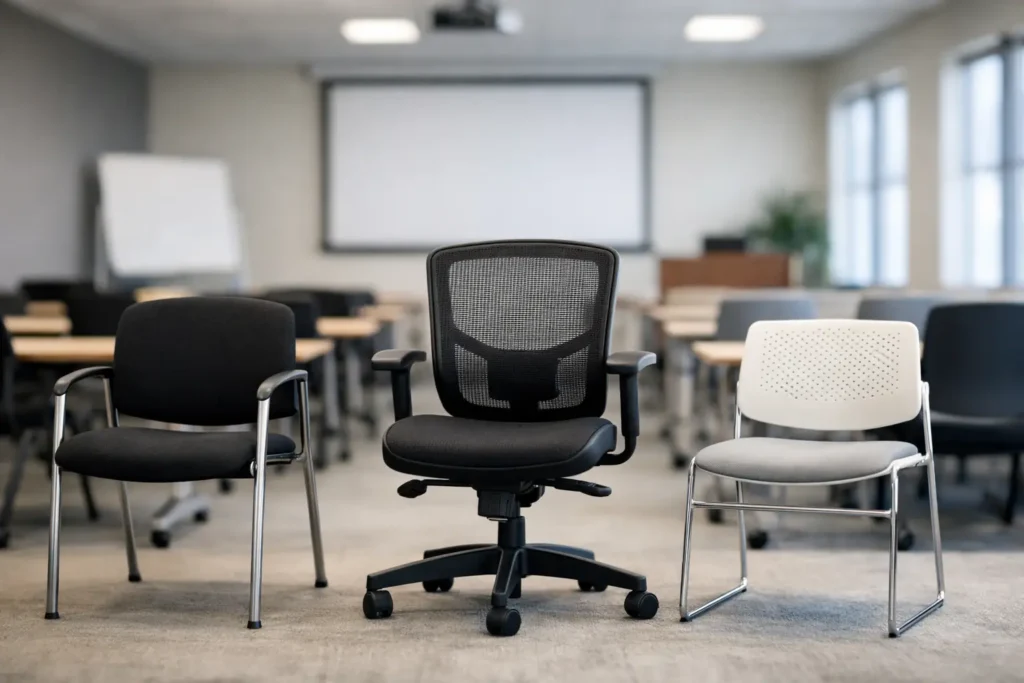
A training room can look polished on opening day and still fail by week three. Usually, the problem is not the layout plan or the technology package. It is the chairs. If seating is uncomfortable, hard to move, noisy on the floor, or wearing out too quickly, every session feels harder to run.
For commercial buyers, knowing how to choose chairs for a training room is less about picking a good-looking model and more about specifying seating that works across people, formats, and years of use. The right chair supports concentration, protects your investment, and keeps the room flexible enough for changing business needs.
How to choose chairs for a training room starts with room use
Before comparing materials, frames, or pricing, define how the room will actually operate. A training room used for two-hour staff briefings needs different seating from a room running full-day certification courses, collaborative workshops, or client presentations.
If the room must switch between classroom, boardroom, and group discussion layouts, mobility matters. If users stay seated for long sessions, ergonomic support moves higher on the list. If turnover is heavy and chairs are handled by different teams, durability and easy maintenance become critical.
This is where many projects go wrong. Buyers often start with a visual reference or a target price, then try to make the chair fit every scenario. A better approach is to match the seating specification to the operational reality of the space. In commercial environments, performance always shows up later, whether it was planned for or not.
Comfort matters, but not in the same way as task seating
Training room chairs do not need the same adjustment range as executive or workstation seating. That said, comfort should never be treated as optional. When users are distracted by pressure points, poor back support, or cramped seat dimensions, attention drops quickly.
For most training environments, look for a chair with a supportive backrest, a seat shape that allows varied users to sit comfortably, and proportions that suit shared use. A lightly flexible back can work well because it accommodates movement without adding the cost or visual bulk of a full ergonomic mechanism.
There is always a trade-off here. Highly padded chairs may feel impressive at first sit, but they can be harder to maintain and less efficient for dense layouts. Slim-profile chairs help maximize capacity and create a cleaner look, but if they are too minimal, they can feel unforgiving in longer sessions. The best commercial choice usually sits in the middle – supportive enough for real use, efficient enough for practical planning.
Mobility, stacking, and storage should be part of the brief
Training rooms rarely stay in one setup forever. Chairs may need to be moved between rows, grouped for workshops, cleared for events, or stored when the room is repurposed. That makes portability a serious buying factor, not a small convenience.
If your team reconfigures the room often, lightweight chairs or models with castors can save labor and reduce disruption. If space is tight, stackable chairs are often the smarter option. They make the room more versatile and reduce the storage footprint when extra seating is not needed.
Still, mobility brings its own decisions. Chairs that are too light can feel less stable. Chairs with castors may be excellent for adaptable learning settings, but they are not always ideal where a more fixed, formal arrangement is preferred. Stacking models are useful, but stackability should not come at the expense of comfort or long-term frame strength. A chair that stores beautifully but performs poorly during use is not a strong specification.
Materials affect lifespan, maintenance, and appearance
In a commercial training room, finishes do more than complete the look. They determine how well the chair holds up under repeated use and cleaning.
Polypropylene and other performance shell materials are often a practical choice for high-use spaces. They are easy to maintain, visually clean, and available in contemporary forms that still support a design-led interior. Upholstered seats or fully upholstered chairs can raise comfort and acoustic softness, especially in corporate or hospitality-style environments, but they require closer attention to fabric selection, stain resistance, and housekeeping routines.
Metal frames usually offer strong durability for frequent-use applications, while timber accents can help create a warmer, more refined look in client-facing settings. The right answer depends on the room’s purpose and the wider interior scheme. In education and large-scale staff training areas, easy-clean surfaces may take priority. In executive learning spaces or premium presentation suites, finish quality and visual consistency may carry more weight.
For buyers furnishing multiple rooms or larger projects, material consistency also matters. If training spaces sit alongside meeting rooms, breakout areas, and lounges, chair finishes should support a coherent commercial environment rather than feeling like an afterthought.
How to choose chairs for a training room without missing durability
Durability is where procurement value is won or lost. A lower upfront price can look attractive on a spreadsheet, but if chairs loosen, scratch, stain, or fail under regular use, replacement costs arrive quickly.
Commercial buyers should assess frame construction, joint quality, surface finish, and the intended use rating of the chair. In training environments, chairs are moved often, used by different body types, and sometimes handled roughly. That is very different from occasional-use visitor seating.
Ask practical questions. Will the chair maintain stability after repeated repositioning? Will the seat finish still look presentable after months of use? Can replacement units be sourced later if the room expands? Is the model suitable for the level of daily traffic you expect?
Reliable supply matters almost as much as the product itself. For multi-room rollouts or brand-standard environments, consistency across batches is important. A trusted commercial furniture supplier should be able to support not only initial selection but also continuity, customization, and project coordination when requirements evolve.
Layout density changes what works best
A chair can perform well on its own and still be wrong for the room. Training spaces are planned around circulation, sightlines, writing surfaces, and occupancy targets, so chair dimensions matter more than many buyers expect.
If you need to fit a higher number of attendees, compact profiles become valuable. Narrower chairs with clean lines can improve capacity without making the room feel crowded. But going too small creates another problem – users feel restricted, and the room starts to look efficient at the expense of comfort.
Chairs with integrated writing tablets can be useful in some settings, especially where speed of setup matters and tables are not practical. However, they are less flexible for collaborative formats and may not suit laptop-heavy training sessions. In many office and institutional environments, pairing versatile training chairs with modular tables gives better long-term adaptability.
This is why layout planning should happen alongside product selection. The smartest specification is not just a chair with good features. It is a chair that works with the room’s footprint, storage conditions, and training formats.
Design still matters in professional learning spaces
A training room is part of the brand environment. Whether it sits in a corporate office, education facility, healthcare setting, or hospitality property, the seating contributes to how the space is perceived.
Design-conscious buyers should not have to choose between function and visual appeal. Contemporary commercial chairs now offer cleaner forms, stronger finish options, and better alignment with broader interior schemes. That makes it easier to specify seating that feels considered rather than purely utilitarian.
This is especially relevant for businesses that host clients, partners, or external participants in their training spaces. A well-furnished room signals professionalism and attention to detail. It tells users the space was planned with purpose.
For larger fit-outs, it also helps to source from a supplier with a broader commercial range, so training room chairs can align with adjacent tables, breakout seating, and collaborative furniture. That creates a more cohesive result and simplifies the specification process. At VCUS, this project-led approach helps buyers create practical, stylish environments without overcomplicating procurement.
Budget should be managed across lifecycle, not unit cost alone
Every commercial project has a budget, and training rooms are often expected to deliver value efficiently. But the cheapest chair is rarely the most economical choice once maintenance, replacements, and operational inconvenience are factored in.
A better way to evaluate budget is to look at total lifecycle value. Consider durability, ease of cleaning, expected frequency of use, and how long the design will remain relevant. A slightly higher investment in a well-made chair can reduce replacement cycles and preserve the room’s appearance for longer.
There is also value in getting the specification right the first time. Incorrect chair selection can lead to user complaints, space planning revisions, and avoidable procurement delays. For project teams balancing timelines and cost controls, that kind of disruption is expensive.
The strongest buying decisions usually come from balancing four things at once: comfort, flexibility, durability, and visual fit. When one is pushed too far at the expense of the others, performance suffers somewhere down the line.
The best training room chairs are the ones people barely notice because the session runs well, the room stays adaptable, and the furniture continues to perform long after installation. If you are planning a new learning space or upgrading an existing one, choose seating the way experienced commercial buyers do – around use, lifespan, and the standard of environment you want the room to represent.
