
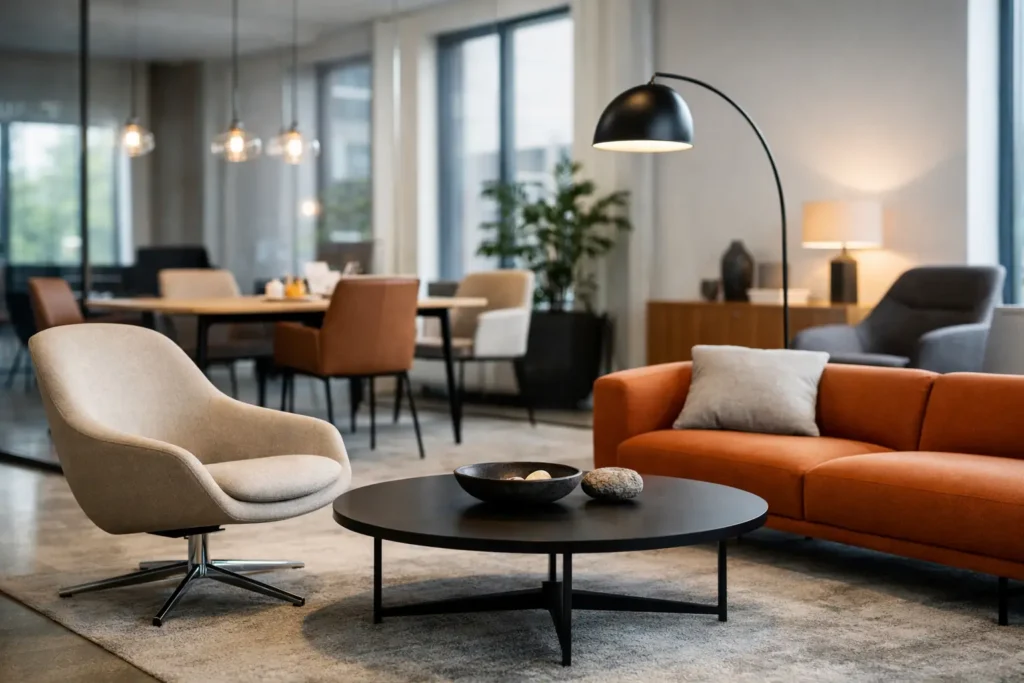
A reception area tells people what to expect before a single word is spoken. The same is true of a boardroom, a hotel lounge, a clinic waiting area, or a campus commons. Designer furniture for business interiors is not just about appearance. It sets the tone for how a space performs, how a brand is perceived, and how comfortably people move through the environment day after day.
For commercial projects, furniture decisions carry more weight than they do in residential settings. A chair in a cafe may be used hundreds of times a week. A sofa in a hotel lobby has to look composed under constant traffic. Office seating must support staff over long working hours, while still fitting the wider design language of the workplace. This is where a design-forward but commercially grounded approach matters. The goal is not to fill a space with statement pieces for their own sake. The goal is to specify furniture that looks aligned, works hard, and stays consistent across the entire project.
What designer furniture really means in commercial settings
In business environments, designer furniture is often misunderstood as a premium layer added at the end of a fit-out. In practice, it should be treated as part of the project framework from the start. Good commercial furniture combines visual clarity, durability, comfort, and repeatability across categories. That combination is what creates a professional interior that feels intentional rather than assembled from disconnected products.
This matters even more when multiple zones need to work together. An office may require reception seating, task chairs, meeting tables, breakout furniture, barstools, and outdoor pieces. A hospitality project may need lounge chairs, dining settings, banquettes, poolside furniture, and occasional tables that all sit within one coherent scheme. If each category is sourced in isolation, the space can quickly lose visual discipline. If the pieces are curated with the full interior in mind, the result feels stronger, more distinctive, and easier to maintain over time.
There is also a practical side to the term designer. In commercial work, design quality is not measured only by silhouette or finish. It is measured by whether the furniture can be specified confidently, customized where needed, delivered reliably, and supported at project scale. A beautiful piece that cannot meet lead times, budget targets, or performance expectations is not a good commercial choice.
Why designer furniture for business interiors affects more than looks
Business owners and project teams often start with aesthetics, but performance usually determines whether a furniture package succeeds. Designer furniture for business interiors contributes to first impressions, but it also influences operations in ways that become obvious after opening.
In offices, well-chosen furniture supports productivity and reinforces company culture. A workplace that mixes ergonomic task seating with polished visitor chairs, collaborative lounge settings, and practical meeting tables sends a clear message about professionalism and care. In hospitality, furniture shapes guest experience directly. Comfort, spacing, material selection, and visual consistency all influence whether a venue feels premium, approachable, or dated.
Healthcare and education bring different pressures. These spaces often need calm, durable, easy-care furniture that supports heavy use without appearing institutional. The design challenge is to create an environment that feels reassuring and contemporary while meeting operational demands. In these settings, furniture can soften the user experience significantly.
There is a branding dimension as well. Interior finishes matter, but furniture is often the element people touch, sit on, and remember. It becomes part of the brand experience. For that reason, commercial buyers should treat furniture as a strategic layer of the interior, not a procurement afterthought.
How to specify designer furniture without losing budget control
A common concern is cost. Many specifiers want a design-led result but need to keep capital expenditure under control. That tension is real, and the answer is usually not to remove design ambition. It is to source more intelligently.
The most efficient commercial projects tend to balance hero pieces with dependable volume items. A lobby may justify a more expressive sofa or lounge chair, while workstations, meeting areas, and dining zones benefit from repeatable products that hold the design language together at scale. This creates visual impact where it matters most while keeping the wider package commercially sensible.
Material selection also affects budget and lifecycle value. Upholstery, laminates, powder-coated metals, timber finishes, and outdoor-grade materials each carry different implications for maintenance and replacement. A lower upfront price can become expensive if the product wears poorly in a high-traffic setting. On the other hand, overspecifying every piece may not be necessary. It depends on usage intensity, cleaning requirements, and expected lifespan.
This is why experienced commercial buyers look for a supplier that can help align style, category breadth, and pricing discipline. When matching chairs, sofas, tables, and ancillary pieces are curated within a clear collection logic, specifying becomes faster and budget management becomes easier. That kind of structure reduces the risk of last-minute substitutions that weaken the scheme.
Choosing collections that create cohesive business interiors
One of the strongest advantages in commercial furniture sourcing is access to style-organized collections. Cohesion is difficult to achieve when every item comes from a different design language. Even when individual products are attractive, the overall space can feel inconsistent if proportions, finishes, and detailing do not relate.
A collection-led approach makes specification more efficient. Instead of solving every room from scratch, designers and procurement teams can work within a family of compatible products. A lounge chair can sit comfortably alongside a sofa, occasional table, dining chair, or barstool because the visual cues are already aligned. This becomes especially useful in mixed-use environments such as hotels, clubs, showrooms, and contemporary office fit-outs.
That said, complete uniformity is not always the right answer. Some projects need contrast to create hierarchy between spaces. A client-facing lounge may call for softer forms and richer finishes, while back-of-house zones should remain simpler and more durable. The key is controlled variation. Cohesion does not mean repetition in every room. It means the project feels connected, even when different areas serve different functions.
What commercial buyers should ask before approving furniture
Before confirming any package, decision-makers should look beyond product images and unit pricing. Commercial furniture needs to work at project level. That means asking whether the supplier can support quantity requirements, customization requests, finish coordination, and delivery scheduling across all categories.
It is also worth checking how pieces perform in real use. Seat comfort, table stability, upholstery suitability, and maintenance demands can change the viability of a product quickly. A showroom environment is valuable because it allows specifiers and clients to assess proportion, finish, and comfort firsthand rather than relying on renders alone.
Customization can be another deciding factor. In many commercial interiors, standard products need adjustment to fit branding, space planning, or operational needs. That may involve upholstery choices, dimensions, table tops, or finish changes. Flexibility here can save a design scheme that would otherwise require compromise.
Finally, buyers should consider supplier reliability as part of product quality. Consistent communication, project handling experience, and the ability to support local and overseas delivery can make a major difference once procurement moves from selection to execution. This is where a trusted commercial furniture supplier such as VCUS adds real value, especially for projects that need both contemporary design and practical control.
The long-term value of designer furniture for business interiors
The best commercial interiors are not remembered only because they looked good on opening day. They continue to support the business months and years later. Furniture plays a major role in that staying power.
When specified well, designer furniture helps reduce visual fatigue, supports daily use, and preserves the quality of the environment under pressure. It contributes to a richer customer experience, a more credible brand presence, and a smoother operational reality for staff. It also protects investment by reducing mismatched replacements and avoidable redesigns.
For architects, designers, contractors, and business owners, the decision is rarely about choosing between design and practicality. In strong commercial projects, those two goals should be working together from the start. The right furniture package brings style, function, durability, and value into one clear specification.
If a space needs to perform commercially, it deserves furniture chosen with the same discipline as every other part of the fit-out.
