
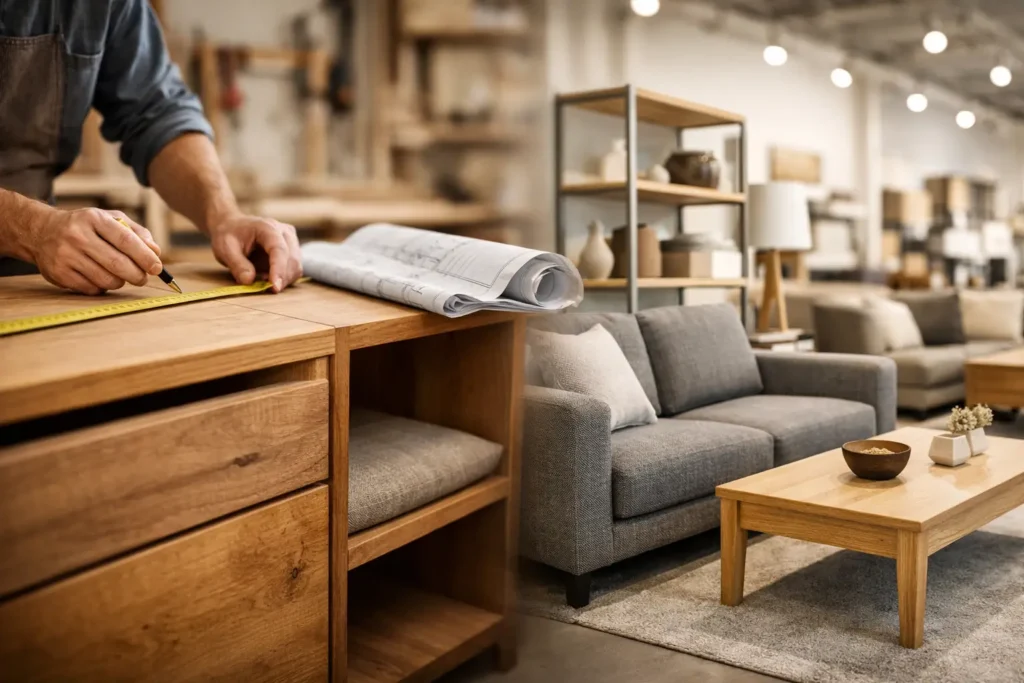
A lobby that photographs beautifully but scuffs within six months is not a good specification. Neither is a workstation plan that saves money upfront but creates daily friction for staff. When buyers weigh custom furniture vs off the shelf, the real question is not which option sounds better. It is which route supports the space, the budget, the timeline, and the operational reality of the project.
For commercial interiors, that decision rarely sits at one extreme. Most successful projects use a mix. The value comes from knowing where customization creates measurable gains and where ready-made pieces keep procurement efficient, cost-controlled, and on schedule.
Custom furniture vs off the shelf: what changes in a commercial project?
The difference goes well beyond appearance. Off-the-shelf furniture is pre-designed, standardized, and typically available in fixed dimensions, finishes, and configurations. It is often the faster path when the layout is straightforward and the design intent can be achieved from existing collections.
Custom furniture is built or modified to meet specific project needs. That may mean adjusting dimensions for a tight footprint, matching brand colors, selecting contract-grade materials, integrating power, improving ergonomics, or developing pieces that align with a wider interior concept. In commercial settings, custom work is less about novelty and more about fit, performance, and consistency.
For a procurement manager, this affects cost planning and lead time. For an interior designer, it affects design control and cohesion. For an operator, it affects how the space functions every day.
Cost is not just the purchase price
Off-the-shelf furniture usually wins on initial unit cost. Standard production lowers manufacturing complexity, and buyers can compare options quickly across categories. For projects furnishing back-of-house areas, training rooms, temporary spaces, or high-volume seating zones, this can be the most practical choice.
But purchase price is only one part of project cost. If a standard item forces layout compromises, leaves wasted space, requires additional site work, or needs early replacement, the lower ticket price can become less attractive over time. A reception counter that almost fits, a banquette that leaves awkward gaps, or a loose table plan that reduces seating efficiency all create downstream cost.
Custom furniture carries a higher upfront investment, but it can reduce hidden inefficiencies. In hospitality and F&B environments, for example, tailored seating dimensions can improve circulation and maximize covers. In offices, custom system furniture can support cable management, zoning, and storage in ways that improve usability from day one. In healthcare and education, the right materials and construction details may also reduce maintenance and replacement cycles.
The better question is not which option is cheaper. It is which option delivers better value across the full life of the project.
Lead time matters more than most teams admit
If a site handover date is fixed, lead time can decide the specification before aesthetics ever do. Off-the-shelf products are usually the safer route when the installation window is tight. Stocked or standard items help teams move quickly, especially when multiple categories need to be coordinated under pressure.
Custom furniture needs more time because there are more decisions to lock down. Drawings, material approvals, prototypes, production, and shipping all add steps. That does not make custom risky by default, but it does make planning non-negotiable.
Experienced project buyers know that the problem is not custom itself. The problem is late custom. If the design team identifies key bespoke elements early, custom pieces can be integrated smoothly into the schedule. If customization starts after other packages are already moving, delays become much more likely.
This is where working with a project-oriented supplier matters. The right partner can advise which pieces should remain standard, which can be modified efficiently, and which truly justify full custom development.
Design cohesion is where custom often proves its worth
Commercial spaces are rarely judged one item at a time. Clients, guests, employees, and visitors experience the environment as a whole. That is why cohesion matters so much across lounges, meeting rooms, workstations, dining areas, breakout spaces, and outdoor zones.
Off-the-shelf collections can absolutely create a polished result, especially when the supplier offers coordinated ranges across categories. For many office, hospitality, and education projects, this is the smartest balance of speed, cost discipline, and design consistency.
Custom furniture becomes more valuable when the concept needs tighter alignment. Think of a branded hospitality venue, a corporate headquarters with signature client-facing spaces, or a showroom where every material transition needs to feel intentional. In these cases, bespoke sizing, upholstery, finishes, and detailing can bridge the gap between a good-looking space and one that feels fully resolved.
That does not mean every item should be custom. A practical approach is to customize the pieces that define the visual identity of the project, then support them with well-selected standard products across the rest of the scheme.
Performance and durability should drive the decision
A beautiful chair is not suitable for a waiting area simply because it looks right. Commercial furniture must perform under repeated use, cleaning protocols, movement, and wear. This is where buyers need to separate residential-style appeal from contract suitability.
Off-the-shelf commercial-grade products can perform extremely well when properly specified. For many applications, tested standard models are actually the lower-risk choice because their construction and finish options are already proven in similar environments.
Custom furniture can improve performance when standard specifications fall short. A hospitality banquette may need heavier-duty foam, stain-resistant upholstery, and reinforced framing. An office table may need specific dimensions to maintain circulation while accommodating equipment. A healthcare lounge chair may require more appropriate material selections for hygiene and maintenance.
The key is not assuming custom automatically means better quality. Quality depends on engineering, materials, production standards, and supplier oversight. Custom without strong project control can create inconsistency. Standard furniture from a dependable commercial source can outperform a poorly developed bespoke piece every time.
Where off-the-shelf makes the most sense
There are many commercial scenarios where standard products are the better call. Large-volume requirements, straightforward layouts, multi-site rollouts, and budget-sensitive projects often benefit from ready-made collections. If the objective is to furnish efficiently while maintaining a clean, contemporary look, off-the-shelf furniture can be the smarter procurement strategy.
It is especially effective when buyers need matching pieces across several categories. A curated supplier with chairs, tables, lounge seating, barstools, outdoor furniture, and office solutions in coordinated styles can simplify selection dramatically. That reduces specification time and helps teams build a cohesive interior without overcomplicating the process.
For repeatable environments, standardization also helps future maintenance and replacement. Facilities teams appreciate being able to reorder proven models instead of reinventing the specification every time.
Where custom earns its place
Custom furniture is most valuable where constraints or brand ambitions are specific enough that standard products create compromise. Built-in seating, unusual footprints, feature pieces, integrated storage, branded finishes, and signature client-facing zones are common examples.
It also makes sense when a project needs to balance aesthetics with unusual functional demands. A restaurant may need seating that maximizes capacity without making the floor feel crowded. An executive office may need furniture proportions that suit architecture not typical catalog dimensions. A country club or boutique hospitality space may need a look that feels distinctive without losing commercial durability.
In these cases, customization is not indulgence. It is a tool for solving design and operational problems more precisely.
The best commercial answer is often both
The strongest procurement strategies are rarely ideological. They are selective. Standard furniture handles the categories where speed, value, and proven performance matter most. Custom furniture is reserved for the areas where fit, identity, or functionality justify the added effort.
That hybrid approach gives teams more control over budget allocation. Instead of overspending across the board, they can invest in the pieces that shape first impressions or solve complex planning issues while using well-designed off-the-shelf products to complete the rest of the environment.
For many professional buyers, that is the sweet spot: a project that feels distinctive, stays commercially grounded, and remains realistic to deliver.
Choosing the right route for your next fit-out
If you are comparing custom furniture vs off the shelf for an office, hotel, F&B venue, healthcare space, or education project, start with four practical questions. Which areas truly need design flexibility? Where can standard dimensions work without compromise? What does the timeline allow? And where will durability have the biggest operational impact?
Those answers usually make the path clearer. Not every space needs bespoke development. Not every project should be furnished from a catalog alone. The right decision comes from aligning furniture selection with project goals, not from forcing a single method across every zone.
This is where an experienced commercial supplier adds real value. A partner who understands categories, lead times, customization scope, and project coordination can help buyers avoid expensive over-specification on one end and false economy on the other. For design-led commercial environments, that balance matters.
If your fit-out needs to look cohesive, perform well, and stay within budget, treat furniture selection as part of project strategy, not just product sourcing. That is usually where better spaces begin.
