
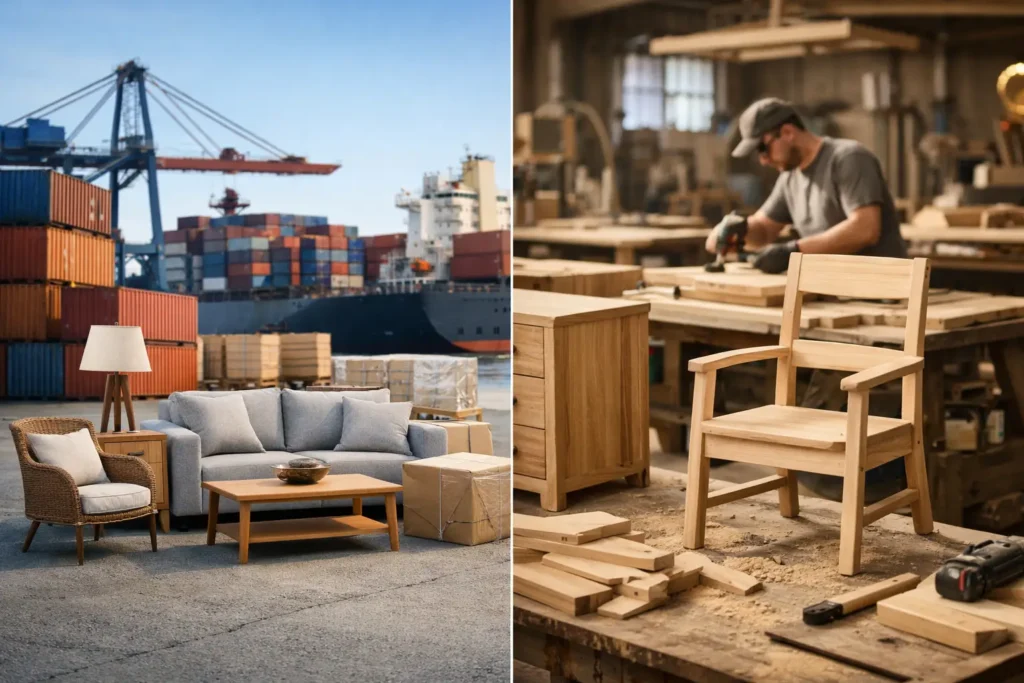
A hotel lobby opening date does not move just because a shipment is delayed. An office handover does not get easier because a custom finish looks great on paper but misses compliance on site. For commercial buyers, imported furniture vs local manufacturing is rarely a simple cost comparison. It is a project decision that affects lead times, design consistency, budget control, replacement planning, and the overall experience of delivering a space that performs well from day one.
For interior designers, procurement teams, architects, and business owners, the real question is not which option is universally better. It is which sourcing model best supports the demands of the project in front of you. In many commercial environments, the strongest result comes from understanding where imported pieces create value, where local production reduces risk, and where a mixed approach gives you the best balance of style, function, and price discipline.
Imported furniture vs local manufacturing: what really changes
At a glance, both options can meet a commercial brief. Both can deliver seating, tables, lounge pieces, outdoor furniture, and system furniture suitable for offices, hospitality venues, healthcare spaces, educational institutes, and showrooms. The difference shows up in the details that matter during specification and execution.
Imported furniture often brings broader design language, access to specialized collections, and stronger variety across matching categories. That matters when a project needs a cohesive look across reception areas, meeting rooms, workstations, breakout zones, dining spaces, and outdoor settings. A curated imported range can make it easier to maintain a consistent visual identity without forcing the design team to piece together products from multiple unrelated sources.
Local manufacturing tends to offer greater flexibility when dimensions, finishes, and technical requirements need to be adjusted quickly. That can be especially useful in renovation work, irregular floor plans, or projects with changing site conditions. When buyers need modifications after drawings are finalized, local production can be more responsive than an overseas factory working to longer production cycles and shipping windows.
Neither route guarantees quality or value on its own. The supplier’s standards, factory control, materials, engineering, and project management matter more than the label of imported or local.
Cost is more than the unit price
The most common mistake in commercial sourcing is comparing only the quoted price per item. A chair that looks less expensive on paper may become more costly once freight, storage, duties, coordination time, and replacement difficulty are factored in. On the other hand, a locally made item with a higher initial quote may reduce downstream issues if it allows faster revisions, easier reorders, or better fit for the site.
Imported furniture can be highly competitive on price, especially when produced at scale. Large-volume manufacturing often lowers per-unit cost and opens access to design-forward products that would be expensive to produce in smaller local runs. For projects furnishing multiple zones at once, this scale can support better overall value.
Local manufacturing may carry a premium in labor or smaller production batches, but that does not always make it the more expensive option. If the project needs repeated prototyping, non-standard sizing, or phased delivery, local production can reduce costly mistakes. It may also lower the risk of ordering too much stock too early, which ties up budget and warehouse space.
Smart procurement teams look at total project cost, not just purchase cost. They ask how each sourcing route affects installation timing, defect resolution, design changes, and long-term maintenance.
Lead times, reliability, and project risk
In commercial fit-outs, timing is often the deciding factor. Imported furniture usually requires longer planning horizons. Production slots, international freight, port congestion, customs clearance, and final-mile coordination all need to be managed carefully. If the schedule is realistic and the supplier has strong logistics control, imported furniture can work very well. If the timeline is compressed or still shifting, the margin for error gets smaller.
Local manufacturing generally offers more agility. Site dimensions can be confirmed later, revisions can be addressed faster, and urgent replacements can be produced without waiting for overseas shipment cycles. For projects with phased openings or fast-track programs, that flexibility can be a major advantage.
Still, local does not automatically mean fast. Capacity limits, material availability, and workshop scheduling can create bottlenecks. Imported does not automatically mean risky either. An experienced commercial supplier with established sourcing channels, showroom-based specification support, and reliable delivery planning can make imported collections highly dependable for project work.
The right question is this: how much schedule certainty does the project need, and how much change is likely after approval?
Design consistency and specification efficiency
Commercial interiors rarely succeed on standalone hero pieces. They succeed when the full environment feels intentional. A workplace needs seating, tables, collaboration zones, storage, and lounge elements that work together visually and functionally. A hospitality project needs continuity across lobby, guest-facing dining, lounge, and outdoor areas. This is where imported collections often have a strong edge.
Many imported commercial ranges are built as coordinated families. That allows specifiers to select matching pieces across categories, with complementary materials, proportions, and finishes. It simplifies the decision process and helps protect the design concept across a large footprint.
Local manufacturing can absolutely support a cohesive result, particularly when there is a strong design brief and a capable production partner. It is often the better route when a project needs built-to-fit banquettes, custom table sizes, or furniture adapted to local operational realities. But creating an entire collection from scratch can require more time, more approvals, and more design management.
For many buyers, efficiency matters almost as much as originality. If a supplier can present style-organized options that already work together, specification becomes faster and safer.
Quality, durability, and commercial performance
Commercial furniture is judged differently from residential furniture. It must handle frequent use, cleaning protocols, movement, and wear across months and years, not just look good in a showroom. That is why imported furniture vs local manufacturing should always be evaluated through the lens of performance.
Imported products can offer excellent quality, especially when sourced from experienced factories with proven commercial standards. The best imported ranges are engineered for repeatability. Buyers can often expect consistency across large orders, which is critical in multi-room or multi-site projects.
Local manufacturing offers the advantage of closer oversight. Materials can be reviewed directly, samples can be adjusted quickly, and workmanship can be checked with fewer layers between buyer and production. This can be valuable for high-contact settings such as restaurants, clinics, training spaces, and executive offices where finish quality and practical durability need to align closely.
The trade-off is that quality control depends heavily on the actual maker, not the category. A poor local workshop will not outperform a disciplined overseas factory. A weak imported source will not beat a skilled local producer. Commercial buyers should focus on testing, sample approval, material suitability, and the supplier’s ability to stand behind what they deliver.
When local manufacturing makes more sense
Local manufacturing is often the stronger choice when the project calls for customization that goes beyond finish selection. Built-in dimensions, unusual footprints, regulatory requirements, or brand-specific detailing can all favor local production. It also makes sense where replacement speed matters, such as active hospitality venues or healthcare environments that cannot wait months for a matching piece.
It is also a practical route when stakeholder approvals are still evolving. If a client may revise upholstery, dimensions, or layout after mock-up, local production can reduce the cost of change. That flexibility is valuable, especially in renovation and retrofit work where hidden site conditions often appear late.
When imported furniture creates better value
Imported furniture is often the better fit when the project needs a wider design vocabulary, stronger cross-category coordination, and scalable pricing across larger volumes. It works well for businesses that want a polished, contemporary, commercial-grade result without overcomplicating specification.
For designers and procurement teams furnishing an entire office, club, restaurant, or educational facility, imported collections can streamline selection and support a more unified space. When managed by a trusted commercial furniture supplier with both sourcing and project experience, imported ranges can offer strong value without sacrificing reliability.
This is where a hybrid model becomes especially useful. A business may import core collections for consistency across chairs, lounges, tables, and barstools, while using local manufacturing for custom counters, banquettes, feature pieces, or size-specific solutions. That approach often gives the best commercial outcome: design cohesion where standardization helps, and flexibility where the project demands it.
The better sourcing decision starts with the brief
There is no serious commercial buyer who should choose purely on the basis of imported or local as a label. The better decision comes from matching the sourcing route to the brief, the timeline, the operating environment, and the budget realities of the project. Some spaces need broad coordinated collections. Some need customization and fast adaptation. Many need both.
At VCUS, that is how project furniture should be approached – not as a one-size-fits-all transaction, but as a sourcing strategy built around the space you are delivering and the experience you want that space to create. When the supplier understands design intent, commercial use, and execution risk at the same time, the imported-versus-local question becomes much easier to answer.
The most reliable furniture plan is the one that keeps your concept intact, your program on schedule, and your client confident long after installation day.
