
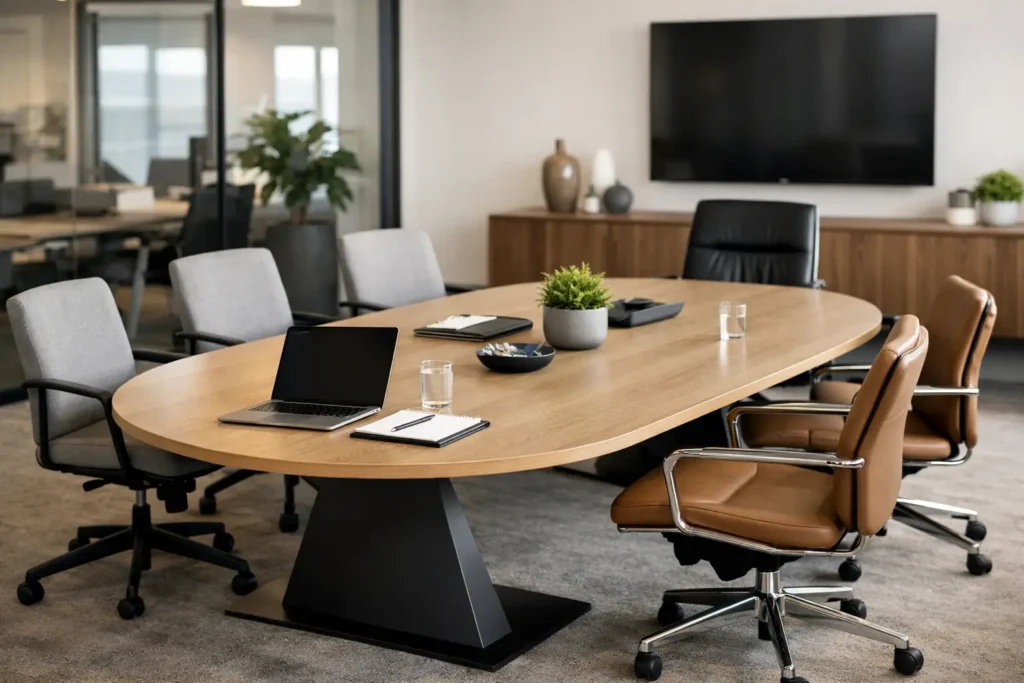
A meeting room can look polished on paper and still fail the moment people sit down. The table is usually the reason. Too large, and circulation suffers. Too small, and the room feels under-equipped. Wrong shape, and collaboration becomes awkward. This office meeting table guide is built for commercial buyers who need more than a nice-looking centerpiece – they need a table that works for layout, technology, durability, and the overall design direction of the space.
For interior designers, procurement teams, and business owners, the meeting table is not an isolated purchase. It affects chair selection, power access, room acoustics, movement paths, and how the workplace is perceived by staff and clients. In project terms, a good choice supports both performance and specification efficiency.
Why the right office meeting table matters
A meeting table carries more pressure than its footprint suggests. It has to support formal presentations, internal discussions, video calls, quick one-to-ones, and at times, impromptu workspace overflow. In many offices, it is one of the most visible furniture investments, especially in boardrooms, client-facing meeting suites, and leadership spaces.
The strongest specifications balance image with day-to-day use. A refined table finish may elevate the room, but if it scratches easily or shows every fingerprint, maintenance becomes a problem. A large statement table may impress visitors, but if users cannot move comfortably around it, the room becomes frustrating. That trade-off matters in real projects, where furniture must perform long after handover.
Start with room function, not just table style
The first question is not what the table should look like. It is how the room will actually be used. A boardroom serving senior leadership has different requirements from a six-person collaboration room or a multi-use meeting space inside an agile office.
If the room is meant for formal decision-making, the table often needs a stronger presence, cleaner detailing, and integrated power or cable management. If the space is used for brainstorming and shorter sessions, flexibility may matter more than executive styling. In training or hybrid work environments, modular formats can make better sense than one fixed table.
This is where many projects go off track. Buyers choose a table based on visual appeal alone, then try to make the room adapt around it. The better approach is to define meeting behavior first, then specify shape, size, base style, and features accordingly.
Office meeting table guide to size and seating
Sizing should be driven by realistic occupancy, not idealized maximum capacity. If a room regularly hosts eight people, specifying a table for twelve may waste valuable floor area and make the room feel oversized for daily use.
Comfortable planning also requires looking beyond seat count. Users need elbow room, chair clearance, and space to enter and exit without disrupting others. In commercial settings, circulation around the perimeter is critical, especially where meetings involve frequent movement, presentations, or shared screens.
As a practical benchmark, each person should have adequate tabletop width for laptops, notebooks, and personal items. Tight seating might work for occasional short meetings, but it tends to reduce comfort in longer sessions. For premium client-facing rooms, a more generous spacing standard is usually worth it.
Room proportions matter too. A narrow room may suit a rectangular table, but only if there is enough side clearance for chairs and passage. In a more square room, a round or boat-shaped table can often create a better sense of balance.
Choosing the right shape
Table shape changes the tone of a room as much as the material or finish. Rectangular meeting tables remain the most common for good reason. They are efficient, familiar, and easy to align with screens, ceiling features, and room architecture. They also suit formal environments where there is a clear presentation direction.
Round tables encourage more equal participation and can soften the feel of compact meeting rooms. They work well for small-group discussions, interview rooms, and collaborative spaces where hierarchy is less important. The trade-off is that larger round tables can consume floor area quickly and may not support screen-sharing as effectively.
Oval and boat-shaped tables offer a middle ground. They keep a professional, boardroom-ready look while improving sightlines and conversational flow. For many commercial projects, this shape works especially well in executive meeting rooms because it feels more refined without being overly rigid.
Modular tables deserve consideration when adaptability is a priority. They are useful in training rooms, seminar spaces, and offices where layouts change frequently. The compromise is visual continuity. A modular solution may not deliver the same clean, architectural statement as a single-piece meeting table, but it can outperform fixed formats in flexible workplaces.
Materials and finishes for commercial durability
An office meeting table should not be specified like residential furniture. Commercial use is harder, more frequent, and less forgiving. The surface needs to handle laptops, bags, coffee cups, cleaning routines, and constant contact without degrading too quickly.
Laminate remains a practical choice for many projects because it offers strong durability, finish consistency, and budget control. It is especially useful where multiple rooms need a cohesive look at scale. Veneer delivers a warmer and more elevated appearance, often suited to executive environments, but it may require more care depending on the finish system and expected traffic.
Solid surfaces and premium composite tops can work well in high-use spaces where buyers want a clean, contemporary appearance with strong maintenance performance. Powder-coated metal bases are common for stability and longevity, while designer base options can create a more distinctive profile when the room needs stronger visual impact.
Finish selection should also consider the wider interior palette. A meeting table should feel integrated with task seating, storage, flooring, and feature walls. In project work, that cohesion matters. It helps the space feel intentional rather than assembled from unrelated pieces.
Cable management, power, and hybrid meeting needs
Technology planning should happen early. A beautiful table becomes a weak specification if power access is clumsy or cables are exposed across the floor. In hybrid workplaces, this issue is no longer optional. Many meeting rooms now need to support screens, conferencing devices, personal charging, and clean connectivity as standard.
Integrated power modules, cable trays, under-top access, and base concealment can dramatically improve usability. The best solution depends on the room’s floor condition, power source location, and expected technology load. A minimalist table may look impressive in a showroom, but if it cannot accommodate the required hardware, it may not be the right commercial choice.
This is also where coordination with contractors and designers becomes important. Furniture should work with the fit-out, not compete with it. Early planning avoids common problems such as misaligned floor boxes, visible cable clutter, or tables that block equipment positioning.
Matching table style to brand and space type
Not every office should specify the same meeting table language. A law firm, creative agency, healthcare operator, and education provider may all need durable meeting furniture, but the design expression should reflect the brand and operating environment.
Executive spaces often call for stronger material character, cleaner detailing, and a more substantial visual presence. Collaborative zones may benefit from lighter forms, softer edges, and a less formal feel. Client-facing meeting rooms usually sit somewhere in between – polished enough to represent the business well, but practical enough for regular use.
For specifiers managing multi-room projects, consistency across categories is just as important as the table itself. That is where working with a project-oriented supplier becomes valuable. Coordinating meeting tables with office seating, lounge pieces, and ancillary furniture creates a more complete environment while reducing sourcing friction. VCUS supports this kind of cohesive commercial specification with style-led collections, customization options, and project-friendly supply.
Budget control without under-specifying
Cost matters in every fit-out, but the lowest purchase price rarely tells the full story. A cheaper table that damages easily, feels unstable, or fails to support cable management can create replacement and maintenance costs far sooner than expected.
Smart budget control means identifying where to invest and where to standardize. In flagship boardrooms or high-visibility client spaces, a more premium specification may be justified. In back-of-house meeting rooms or high-volume rollout projects, durable standardized solutions often make better commercial sense.
Lead time is part of the value equation as well. Buyers should confirm stock availability, customization timelines, delivery scope, and installation coordination before final approval. A well-priced table is only useful if it arrives on time and in the right specification.
What experienced buyers check before approval
Before signing off, it helps to review the table in context. Look at actual room dimensions, seating type, access routes, and finish compatibility with surrounding elements. If possible, assess samples or showroom pieces rather than relying only on images.
Experienced specifiers also test practical details. Does the base interfere with legroom? Will chairs tuck in properly? Is the top finish suitable for the level of use? Are power modules positioned where people naturally sit? These are small questions that prevent costly adjustments later.
The best meeting table decisions are rarely made in isolation. They come from aligning design intent, room function, durability, technology, and procurement realities into one clean specification.
Choose a table that helps the room perform from day one and still feels right years into use. That is usually the difference between furniture that fills a space and furniture that strengthens the whole project.
