
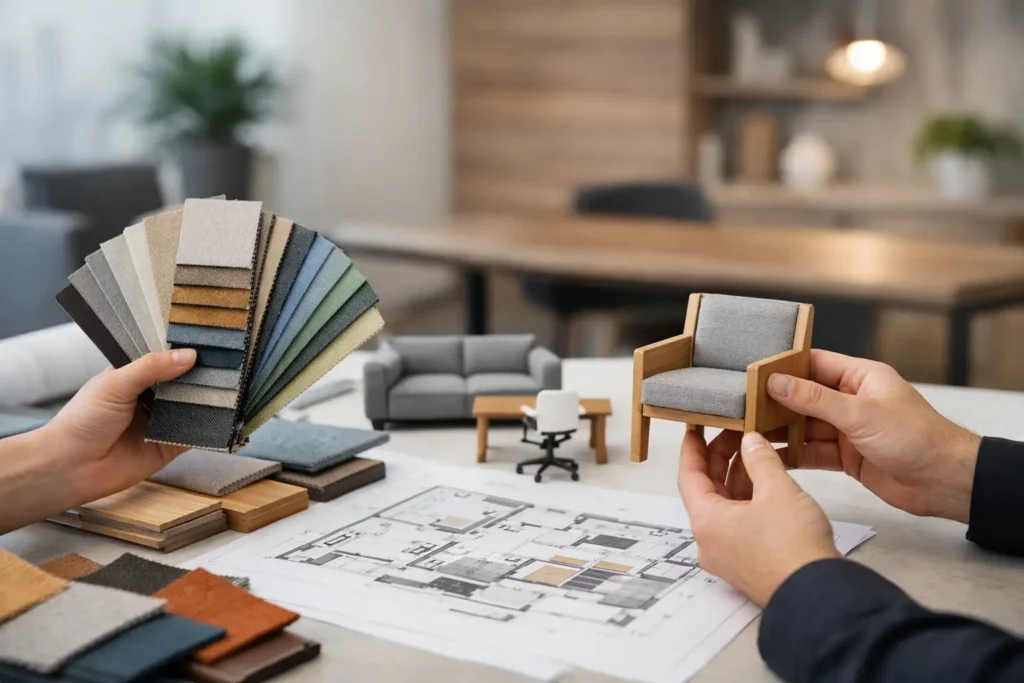
A hospitality lounge that photographs beautifully but stains after three months is not a design win. An office workstation that fits the floor plan but ignores cable access is not value engineering. If you are figuring out how to customize project furniture, the real goal is not to make pieces look different. It is to make every item work harder for the space, the user, and the project budget.
In commercial environments, customization is rarely about novelty. It is about fit, consistency, durability, compliance, and procurement control. The best customizations solve project constraints without creating new risks in lead time, maintenance, or replacement planning.
How to Customize Project Furniture with a Clear Brief
The fastest way to derail a furniture package is to start with finishes before defining the operating needs of the space. A good customization brief begins with function. Who will use the furniture, how often, and under what conditions? A boardroom chair, a café chair, a waiting area sofa, and a training table may all sit within one project, but they should not be customized with the same priorities.
For offices, ergonomics, mobility, integrated power, and easy maintenance tend to shape the decision. In hospitality, the focus often shifts toward visual identity, guest experience, cleanability, and heavy-use performance. Healthcare and education projects add another layer, where hygiene, safety, and practical durability can outweigh purely aesthetic preferences.
Before you approve any customization, define the non-negotiables. That usually includes dimensions, usage level, material performance, cleaning requirements, target budget, and delivery deadline. Once those are locked in, design choices become easier because the project team is evaluating options against a clear commercial purpose, not individual taste.
Start with the Pieces That Set the Standard
Not every item in a project needs the same level of customization. In fact, trying to customize everything at once often creates unnecessary cost and slows approvals. A more disciplined approach is to identify the anchor pieces first. These are the products that establish the visual language and performance expectations for the rest of the space.
In a corporate office, that might be task seating, meeting tables, and reception furniture. In a hotel or restaurant, it could be dining chairs, barstools, lounge seating, and occasional tables. Once those core items are defined, it becomes much easier to specify supporting pieces that feel consistent without requiring one-off development across the whole project.
This matters because commercial interiors are judged as complete environments, not as isolated products. A coordinated palette across chairs, sofas, tables, and lounge furniture creates a stronger impression than heavy customization on one item and generic selections everywhere else. For most projects, consistency delivers more value than excessive variation.
Dimensions should follow space planning, not guesswork
Custom sizing can be one of the most useful tools in project furniture, but it needs discipline. A banquette that is 2 inches too deep can affect circulation. A custom table base can interfere with legroom. A lounge chair with a wider footprint may work in the showroom but fail on site when paired with actual spacing and traffic flow.
That is why dimensions should always be checked against layouts, clearances, access routes, and intended occupancy. It is not enough to ask whether a piece fits the room. It has to fit the way the room will be used.
Finishes should reflect use, not just concept boards
Woodgrain, metal color, upholstery tone, and tabletop finish all influence the final look, but commercial use should guide the shortlist. Matte finishes may mark more easily in some settings. Light fabrics may support a brand concept but increase maintenance pressure in high-turnover venues. Textured surfaces can add warmth, yet in healthcare or education, simpler cleanable finishes may be the better long-term choice.
The right answer depends on where the furniture will live and how much abuse it will take. A finish that feels premium in a low-traffic executive suite may be the wrong fit for a busy café or student commons.
Materials, Performance, and Trade-Offs
This is where many furniture decisions become expensive. A project team falls in love with a look, then realizes too late that the material cannot perform at commercial level or cannot meet the program budget at scale.
Customization works best when aesthetics and performance are evaluated together. Upholstery is a good example. Leather, faux leather, woven fabric, and performance textiles all create different impressions and maintenance demands. The right pick depends on abrasion resistance, cleaning method, user comfort, and replacement strategy. A material that feels luxurious may not be ideal for a high-turnover restaurant. A practical healthcare-grade surface may not suit a boutique hospitality concept unless it is selected carefully.
The same applies to frames, foam density, joinery, and table construction. In a project setting, what sits beneath the finish matters as much as the finish itself. If a chair needs to stack, if a sofa must hold shape in a waiting area, or if an outdoor table needs weather resistance, those technical needs should lead the customization conversation.
There is always a trade-off. More custom usually means more decisions, more approvals, and sometimes longer production time. Premium materials can elevate a space, but they need to justify themselves through longevity, guest impact, or brand value. Value engineering is not about stripping out design. It is about putting budget where it delivers measurable benefit.
How to Customize Project Furniture Without Delaying the Project
Customization can improve a project, but it also adds complexity. The most common mistake is treating custom furniture like an off-the-shelf purchase with a different fabric. In reality, every change to dimensions, material, finish, base type, stitching detail, or table edge profile can affect pricing, production drawings, mockups, and lead times.
A reliable process usually follows a simple order. First, approve the model and construction type. Next, confirm dimensions and configuration. Then finalize finishes and materials. After that, review samples or mockups where needed before full production begins. When teams jump between these stages or keep revisiting earlier decisions, timelines slip fast.
Procurement teams and designers should also think beyond first delivery. If future phases or replacement orders are likely, document every customization clearly. Fabric code, timber stain, metal finish, dimensions, and special details should all be recorded in a project schedule. That protects consistency later, especially across multi-site rollouts.
Mockups are worth it when the stakes are high
Not every item needs a prototype, but some do. Built-in banquettes, reception counters, custom meeting tables, and signature seating for hospitality spaces often justify a sample or mockup. This is particularly useful when several custom decisions interact at once, such as upholstery, stitching, proportions, and base finish.
A mockup helps catch issues while they are still cheap to fix. It also gives clients and operators confidence before the full order moves ahead.
Choose Customization That Scales Across Categories
One of the smartest ways to approach project furniture is to customize at the collection level rather than treating each product as a separate exercise. If a project requires office seating, lounge furniture, café tables, barstools, and outdoor pieces, a coordinated approach saves time and strengthens the result.
That does not mean every item must match exactly. It means the furniture package should share a common logic. Repeated finishes, complementary silhouettes, consistent upholstery families, and aligned detailing create a richer, more intentional environment. For commercial buyers, this is often the point where a project feels polished rather than pieced together.
It also simplifies procurement. Working with a supplier that can support multiple categories, offer showroom-based selection, and guide customization across a broader range reduces the friction of managing separate vendors for every zone. For many professional buyers, that continuity is as valuable as the product itself.
What Good Customization Looks Like in Practice
Good customization is usually quiet. It feels like the furniture belongs in the space because proportions make sense, materials suit the use case, and the visual language stays consistent from one area to the next. It does not call attention to itself as a custom exercise.
A well-specified office project might use one seating family across task, meeting, and visitor settings with different bases and upholstery grades. A hospitality venue might repeat a signature timber tone across dining tables, lounge pieces, and bar furniture while adjusting materials for wear and maintenance in each zone. A healthcare or education project might customize for practical performance first, then refine color and form so the environment still feels contemporary and welcoming.
That is the real value of customization in commercial furniture. It is not about making every piece unique. It is about making the full package more coherent, more durable, and easier to operate.
For buyers planning their next fit-out, the best starting point is simple: customize where it improves function, supports the design intent, and protects the budget. When those three line up, the furniture does more than fill a floor plan. It helps the whole project perform better.
