
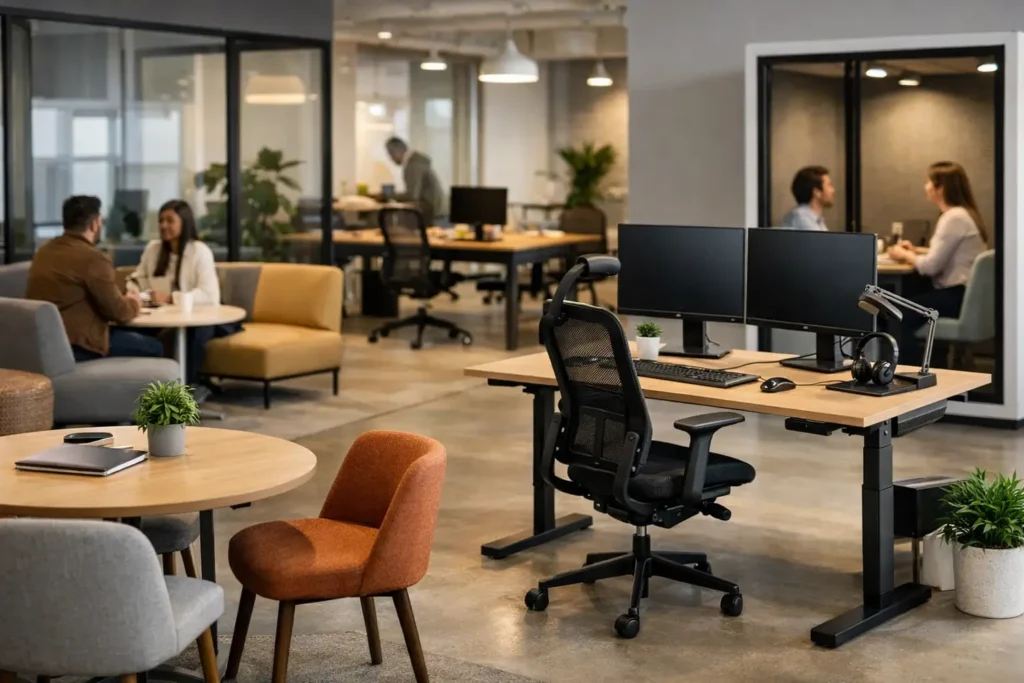
A hybrid office cannot be planned around the assumption that every desk will be occupied from nine to five. The real question is what furniture suits hybrid offices when teams move between focused work, video calls, informal catch-ups, and in-person collaboration throughout the week. The strongest schemes give people a reason to come in: spaces that are comfortable, purposeful, and noticeably better suited to teamwork than a home workstation.
For interior designers, fit-out contractors, and business owners, this calls for more than a larger mix of chairs and tables. It requires a furniture specification that supports changing occupancy, protects the visual character of the workplace, and remains practical to procure, maintain, and reconfigure over time.
Start With Work Modes, Not a Desk Count
Hybrid work changes the planning brief. A workplace may need fewer dedicated desks, yet it often needs more settings overall. Employees who commute into the office expect choice: a quiet place to concentrate, a professional room for client calls, a comfortable lounge for discussion, and a shared table for project work.
Before selecting furniture, map how the organization expects the office to operate. Consider peak attendance days, the balance between resident and visiting staff, the need for confidential conversations, and how often teams host external guests. A company with a heavily client-facing culture will require a more polished reception and meeting environment than a team that primarily uses the office for internal workshops.
This exercise prevents a common mistake: removing desks to make room for collaboration areas, then discovering that the remaining desks, meeting rooms, and phone booths cannot accommodate peak demand. Flexibility should solve a real operational need, not simply follow a workplace trend.
Ergonomic Task Seating and Adaptable Desks
Desking remains the foundation of most hybrid offices, but it should be specified for shared use. Height-adjustable task chairs with adjustable lumbar support, seat depth, armrests, and tilt control are a sound investment where several employees may use the same workstation on different days. A chair that feels acceptable to one person can be uncomfortable for another after several hours.
Bench desks and modular workstation systems make efficient use of floor area while keeping the layout orderly. They are particularly effective for bookable desks, provided each position has accessible power, data provision where required, and sensible cable management. Shared desks need to look clean at the end of every day. Integrated cable trays, modesty panels, and easily cleaned surfaces make that standard easier to maintain.
Sit-stand desks are valuable for teams that spend long periods at screens, although they are not necessary at every workstation. A practical approach is to provide a proportion of height-adjustable positions or a dedicated sit-stand zone. This controls budget while still giving staff meaningful choice.
For compact offices, mobile pedestal storage and personal lockers generally work better than permanent under-desk storage. Lockers give hybrid employees a secure place for laptops, documents, and personal items without tying them to a single desk. Choose durable units with clear numbering, dependable locking options, and finishes that align with the broader interior palette.
What Furniture Suits Hybrid Offices for Collaboration?
Collaboration furniture should support different group sizes, rather than forcing every conversation into an enclosed boardroom. A balanced office includes formal meeting tables, project tables, casual lounge seating, and mobile pieces that can be moved without disruption.
Meeting Tables for Planned Discussions
A well-proportioned meeting table remains essential for presentations, interviews, client meetings, and hybrid video calls. Select table sizes based on room capacity and circulation, not the maximum number of chairs that can physically fit around the perimeter. People need space to move, place devices, and participate comfortably.
Integrated power modules and cable access are particularly valuable in hybrid meeting rooms. Video conferencing equipment, laptops, and charging cables can quickly undermine an otherwise refined setting. A thoughtfully specified table keeps technology present but visually controlled.
For training rooms and multipurpose spaces, folding or mobile tables offer greater adaptability than a fixed boardroom arrangement. They can be grouped for workshops, arranged in rows for presentations, or stored aside for a larger event. The trade-off is that mobile furniture must be genuinely durable. Weak castors, unstable frames, and poor folding mechanisms create maintenance issues in high-use commercial settings.
Project Tables and Informal Gathering Points
High tables, communal tables, and standing-height worktables are useful in active zones where teams gather briefly to review work or exchange ideas. They bring energy to a space and can increase seating capacity, but they should not replace seated meeting options entirely. Standing-height furniture is best used as one choice within a wider workplace ecosystem.
Pair these tables with commercial-grade barstools or counter stools that offer footrests, stable bases, and finishes suited to frequent cleaning. Where staff may work for more than a few minutes, include backrests on at least some stools. A stylish stool without appropriate support can look impressive in a render but see limited use after move-in.
Provide Privacy Without Closing Off the Office
Open-plan offices encourage visibility, but hybrid work has increased the need for acoustically considerate settings. Employees often come in specifically to join video calls, handle sensitive matters, or focus away from household distractions. Soft seating alone will not resolve noise transfer, yet the right furniture helps create useful layers of privacy.
High-back lounge sofas, privacy booths, acoustic screens, and upholstered divider panels can define quieter zones without the cost and permanence of full-height construction. These pieces are especially effective near collaboration areas, reception spaces, and open meeting zones. They also add warmth and visual depth to offices dominated by hard desk surfaces.
Phone booths or compact focus pods are a stronger solution where confidential calls and virtual meetings are frequent. Their quantity should be based on actual behavior. One booth may be sufficient for a small team with occasional calls, while a larger regional office may require several booths distributed across the floor to avoid queues.
When selecting lounge seating, assess both appearance and performance. Commercial upholstery should be suitable for sustained use and cleaning, while sofa dimensions should allow comfortable movement through adjacent circulation paths. Low residential-style sofas may suit a hospitality-inspired lounge, but they are less appropriate if staff need to stand up quickly between meetings.
Make Hospitality Areas Work Harder
A café-style pantry, breakout zone, or client lounge can become one of the most productive areas in a hybrid workplace. These spaces support informal meetings, solo laptop work, staff breaks, and spontaneous interaction, all of which are harder to reproduce through scheduled video calls.
The furniture mix should include dining-height tables for longer breaks, smaller café tables for two to four people, and lounge seating for relaxed conversations. A mixture of table heights gives users control over how they work and socialize. It also helps the area serve different functions across the day without feeling like an oversized pantry.
Material selection matters here. Tabletops should resist stains and daily cleaning, while chairs need commercial-grade frames and glides appropriate for the floor finish. In Singapore and other humid, high-traffic settings, easy-care finishes and dependable construction reduce replacement costs over the life of the project.
Specify a Cohesive, Durable Collection
Hybrid offices contain more furniture categories than conventional desk-led workplaces. Without a coherent approach, the result can feel fragmented: one style for task seating, another for meeting rooms, and unrelated pieces in the lounge. A consistent palette of timber tones, metal finishes, upholstery colors, and silhouettes gives the office a considered identity while allowing each zone to serve a distinct function.
This is where a project-oriented furniture supplier adds value. The ability to source task chairs, workstations, meeting tables, sofas, barstools, and system furniture through a coordinated collection simplifies specification and helps protect consistency across phases, floors, or regional sites. VCUS supports this process with contemporary commercial furniture, customization options, and practical project supply for businesses that need quality without unnecessary cost escalation.
Durability should be assessed beyond the product image. Review frame materials, upholstery suitability, edge detailing, weight capacity, warranty terms, and the availability of replacement components. A low initial price is not always economical if a chair, table base, or mechanism fails early in a busy office.
Plan for Change From Day One
The best hybrid furniture plans leave room for the organization to learn. Attendance patterns, team structures, and technology requirements will change after the office opens. Mobile tables, modular seating, reconfigurable workstation systems, and movable screens allow the workplace to respond without a full renovation.
Not every piece needs to move. Fixed elements such as reception counters, large meeting tables, and primary workstation runs can provide structure. Add flexibility where it has the greatest operational value: training spaces, project zones, touchdown areas, and informal collaboration settings.
A successful hybrid office feels intentional rather than overfurnished. Give every furniture type a clear role, select commercial-quality pieces that can withstand real use, and reserve enough budget for the seating, power access, and acoustic support that make employees want to use the space. The result is an office that remains credible for clients, comfortable for teams, and ready for the next change in how work gets done.
