
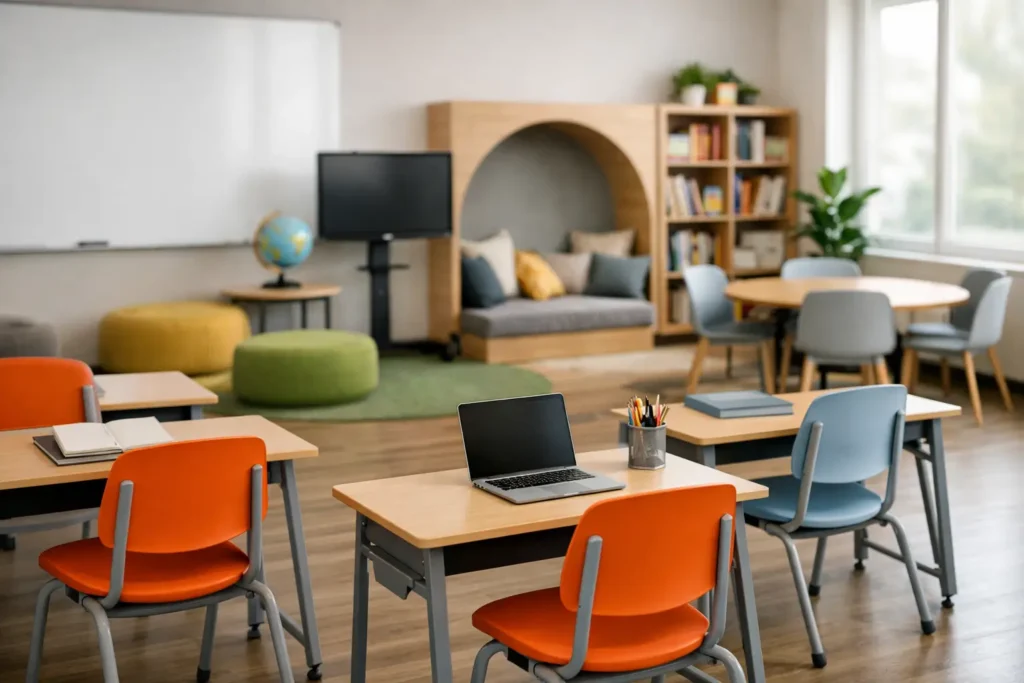
A classroom that looks good in a rendering can fail fast once students, staff, and daily traffic take over. Chairs get dragged. Tables are reconfigured. Bags pile up. Devices need charging. Cleaning becomes constant. That is why how to furnish education spaces is not a styling exercise – it is a planning decision that affects learning, supervision, maintenance, and budget performance for years.
For schools, colleges, training centers, and campus facilities, the right furniture specification has to do several jobs at once. It should support concentration and collaboration, hold up under heavy use, create a cohesive environment across multiple rooms, and stay within project budgets. The strongest results come from treating furniture as part of the operational plan, not the final decorative layer.
How to furnish education spaces by function first
Education projects often go wrong when furniture is selected room by room without a wider logic. A lecture room, library corner, faculty workspace, student lounge, and multipurpose training area may all sit within one campus, but they do not perform the same way. Furnishing them as if they do usually creates visual inconsistency, poor circulation, and avoidable replacement costs.
A better approach is to begin with function. Ask how each space will be used across a normal day, not just during its primary use case. A seminar room may also host exams, workshops, staff briefings, and community events. A student commons may need to support quiet study in the morning and group activity later in the day. Once those patterns are clear, furniture choices become more precise.
This is where professional buyers benefit from category planning. Instead of choosing isolated pieces, specify coordinated seating, tables, lounge elements, and storage that can work across adjacent zones. That creates design consistency while giving the site team more control over maintenance, future top-ups, and phased expansion.
Start with movement, density, and supervision
Before materials, colors, or styles, get the layout logic right. Education environments are high-traffic settings, and circulation matters more than many teams expect. Students move in groups, staff need clear lines of sight, and rooms must be easy to reset between sessions.
If a room is expected to change format often, lightweight tables and stackable or movable chairs usually outperform heavier fixed-looking pieces. In contrast, if the setting is a testing room or formal learning space where stability and order matter most, more structured furniture may be the better choice. There is no universal answer. The right specification depends on whether flexibility or consistency carries more value in that space.
Supervision is another practical factor. In early learning and K-12 settings especially, oversized lounge pieces, high-backed seating, or cluttered layouts can create visibility issues. In tertiary or adult learning environments, those same pieces may be useful for comfort and longer dwell time. Furnish for the age group and the level of staff oversight the room requires.
Durability is not optional
In commercial education settings, furniture is used hard. That changes what “good value” really means. A lower upfront price may look attractive, but if finishes chip, upholstery wears out, or table edges fail under repeated impact, replacement costs arrive quickly.
Durability starts with specification details. Frame strength, edge construction, cleanable surfaces, and replaceable components all matter. So do glides, casters, and joinery. These are not glamorous decisions, but they directly affect how long a project performs.
Materials should also suit the maintenance reality of the site. For example, soft upholstered seating may elevate a library or student lounge, but only if cleaning protocols and fabric selections are appropriate for daily use. In high-turnover classrooms, hard-wearing chairs with easy-clean surfaces may be the more practical choice. In staff rooms and executive education spaces, comfort and finish quality may justifiably take a larger role.
Flexibility matters, but not every room needs to transform
One of the most common assumptions in education fit-outs is that every space must be highly flexible. Sometimes that is true. Sometimes it creates complexity without real benefit.
Modular tables, nesting solutions, mobile whiteboard dividers, and stackable seating are valuable in teaching spaces that regularly switch formats. They help staff adapt rooms without needing extra labor or storage. But if a room has a stable layout all year, over-prioritizing mobility can lead to compromises in comfort, visual order, or durability.
The better question is not whether furniture is flexible. It is whether the flexibility will actually be used. If the answer is yes, specify furniture that moves, stores, and resets easily. If the answer is no, invest in more stable pieces that offer stronger long-term performance.
Design cohesion supports the learning environment
Educational interiors should feel considered, not pieced together. Cohesion builds trust in the institution, helps with wayfinding, and creates a more settled experience for students and staff. That does not mean every room should look the same. It means the project should carry a clear visual language across furniture categories.
A consistent family of chairs, tables, lounge seating, and collaborative furniture can tie together classrooms, waiting areas, faculty rooms, breakout zones, and administrative spaces. This matters on both design and procurement levels. From a design perspective, it creates a more professional environment. From a project perspective, it simplifies approvals, ordering, and future additions.
For many commercial buyers, this is where working with a supplier that can support multiple categories becomes especially useful. A showroom-based, project-oriented approach can help specifiers compare styles, finishes, and proportions across a full scheme rather than making disconnected product decisions.
Furnish different education zones with different priorities
Not all education spaces should be furnished the same way, even within one project.
Teaching rooms need dependable seating and tables sized for the learning model, whether that is lecture-style delivery, discussion, or active group work. Libraries and resource areas need a more balanced mix of focused study furniture, soft seating, and shared tables. Student lounges should feel inviting without becoming difficult to maintain. Faculty and administrative areas need ergonomic task seating, practical storage, and a more professional finish standard for meetings and daily work.
Multipurpose areas are often the most demanding. These spaces may host orientation events, presentations, training sessions, dining overflow, and informal study. They benefit from furniture that can be rearranged quickly while still looking intentional when deployed at scale.
Outdoor campus areas deserve similar care. Weather exposure, heavy use, and safety considerations mean outdoor furniture should never be treated as an afterthought. The right pieces can extend usable campus space and improve the daily student experience, but only if they are genuinely suited to commercial outdoor use.
Budget control comes from smarter specification
Furnishing education spaces well does not mean specifying the most expensive option in every category. It means putting investment where it delivers the most operational value.
High-use classrooms and student common areas usually justify stronger durability and easier maintenance. Accent spending may make more sense in arrival zones, executive areas, or recruitment-facing spaces where first impressions matter. In some projects, a mixed strategy is best – standardized furniture in teaching rooms, upgraded lounge or collaborative pieces in public-facing areas, and selective customization where branding matters most.
Procurement teams should also think beyond the first order. Can the same range be topped up later? Are finishes likely to remain available? Can matching pieces be used in future phases? Budget discipline improves when the furniture strategy supports long-term consistency instead of one-off purchasing.
Work with lead times, not against them
Education projects are often tied to fixed opening dates, holiday shutdowns, or semester schedules. That makes lead time planning critical. Custom pieces, imported collections, and large-volume orders all require realistic scheduling, especially when several categories must land together.
Early coordination between designers, procurement teams, and furniture suppliers reduces risk. So does shortlisting practical alternatives before approvals are finalized. A dependable supplier should be able to advise on stock, customization scope, installation planning, and delivery sequencing rather than simply quoting products.
This is one reason many specifiers prefer to consolidate categories with an experienced commercial partner such as VCUS. It helps reduce fragmentation across the order and brings more control to design consistency, timeline management, and overall project execution.
Test the furniture in real terms
Renderings and tear sheets are useful, but they should not be the only basis for approval. In education settings, proportion, comfort, cleanability, and movement all need to be assessed in practical terms.
If possible, review samples or showroom pieces with the actual users in mind. Sit in the chair for more than a minute. Check table stability. Consider how staff will stack, move, wipe down, and supervise the furniture. Measure clearance properly. The small details that feel minor at selection stage are usually the details that shape daily satisfaction after handover.
How to furnish education spaces successfully comes down to one principle: choose furniture that serves the way the institution really works. When the specification balances durability, flexibility, design cohesion, and budget control, the result is more than a furnished room. It is a dependable environment that supports learning, reflects the institution well, and continues to perform long after opening day.
