
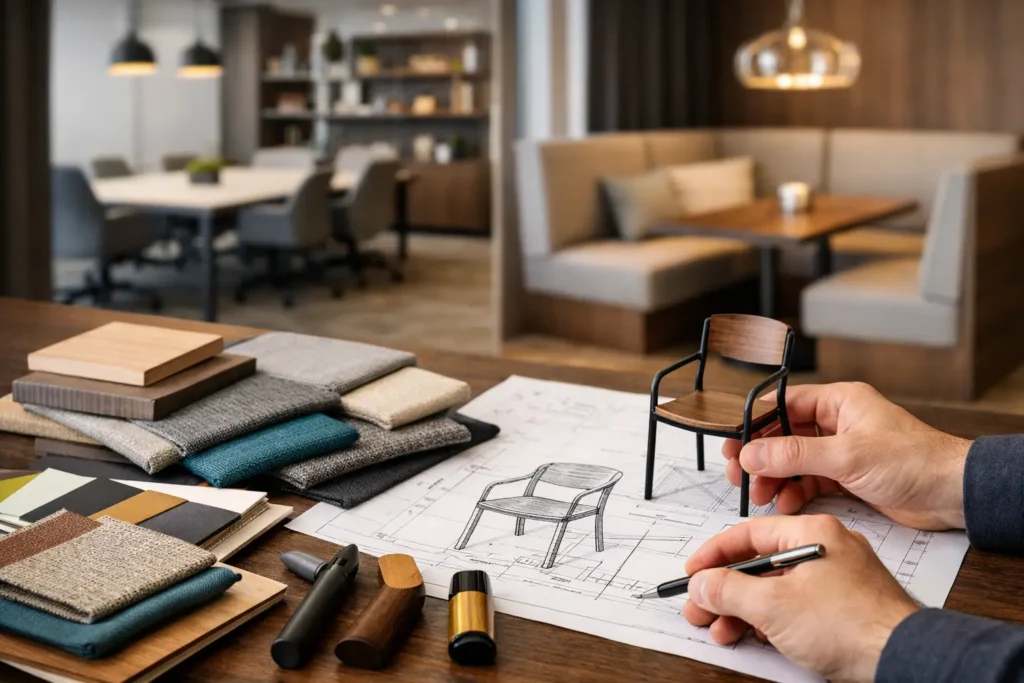
A well-furnished commercial space rarely comes from picking standard pieces straight off a list. Most professional buyers need furniture customization options for commercial projects that support a design concept, meet performance requirements, and stay realistic on budget and timeline. That is where good project sourcing becomes more than product selection – it becomes coordination across aesthetics, use case, compliance, and supply.
For offices, hospitality venues, healthcare settings, education spaces, and F&B environments, customization is usually not about making every piece unique. It is about making the right changes in the right places. A reception lounge may need a signature upholstery finish. Guest seating may need easier-clean surfaces. Training tables may need revised dimensions for a tighter floor plan. The best commercial outcomes come from knowing which options add value and which ones add cost without improving the project.
What furniture customization options for commercial projects usually include
In commercial furnishing, customization often starts with finishes, dimensions, materials, and configuration. These are the options that have the biggest visual and functional impact across a full space. When handled properly, they help buyers maintain consistency from one zone to the next without forcing a fully bespoke manufacturing process.
Finish customization is often the fastest way to align furniture with an interior scheme. A chair frame may be available in several powder-coated colors, wood stains, or metal finishes, while tabletops may offer laminate, veneer, solid surface, or compact-grade options. In a hospitality project, changing the finish can be enough to move a product from casual café styling to a more refined lounge setting.
Dimension customization matters when layouts are tight or when circulation standards are strict. Banquettes, meeting tables, workstations, and lounge seating often need width, depth, or height adjustments. The practical question is whether a dimensional change affects tooling, structural integrity, shipping efficiency, or minimum order quantity. A small adjustment may be straightforward. A major change may shift the piece into semi-bespoke territory with different lead times and pricing.
Material and upholstery customization is another core category. Commercial buyers usually compare fabric, vinyl, leather, mesh, and performance finishes based on abrasion resistance, maintenance needs, and brand image. A healthcare waiting area and an executive boardroom may use the same seating profile but require completely different upholstery specifications.
Where customization has the strongest project impact
Not every category needs the same level of adjustment. Some pieces carry the design identity of the space, while others need to prioritize durability, replacement ease, and cost control.
Seating and lounge furniture
Seating usually offers the broadest customization range. Side chairs, barstools, office seating, sofas, and lounge chairs can often be tailored through upholstery, leg finish, stitching detail, seat foam density, and arm style. For designers and specifiers, this matters because seating appears across multiple touchpoints in a project. Matching tones and textures across dining, waiting, meeting, and breakout areas helps create a cohesive result.
The trade-off is that upholstery choices can affect maintenance and lead time. A premium woven textile may look exceptional in a clubhouse or hotel lounge, but in a high-turn F&B setting, easy-clean vinyl or treated fabric may be the smarter specification.
Tables and work surfaces
Tables are heavily influenced by function. In offices and education spaces, dimensions, cable access, edge profiles, and base types all affect usability. In hospitality, tabletop finish, base stability, and wear resistance matter just as much as appearance. Commercial table customization often focuses on size, top material, thickness, and frame finish rather than dramatic shape changes.
That is usually the sweet spot. You preserve the reliability of a proven product while still adapting it to the floor plan and brand look.
System furniture and modular pieces
System furniture is where configuration becomes more important than individual piece customization. Workstations, modular sofas, storage systems, and partition-based setups are designed to scale across larger layouts. The value here is not only appearance. It is planning efficiency.
For larger rollouts, modular customization supports repeatability. That helps procurement teams maintain consistency across departments, floors, or multiple locations without re-specifying from scratch each time.
How to evaluate the right customization level
Commercial buyers sometimes assume more customization means a better result. In reality, the best specification is usually selective. If every piece is heavily modified, costs rise, approvals slow down, and replacement planning becomes harder.
A better approach is to separate furniture into three groups: signature pieces, functional workhorses, and background support items. Signature pieces are the visual anchors such as reception seating, feature dining chairs, or statement lounge furniture. These deserve more attention to finish, upholstery, and detail. Functional workhorses include task chairs, training tables, and stackable seating where performance and price discipline should lead. Background support items such as side tables or occasional seating may only need finish coordination.
This approach protects both design intent and budget. It also keeps lead times more manageable, which matters in phased fit-outs and projects with fixed opening dates.
Budget, lead time, and minimum order realities
Customization always has operational implications. The earlier these are discussed, the smoother the project runs.
Finish swaps within an existing commercial range are usually the most efficient option. They can deliver strong visual alignment with less disruption to production. Full dimensional redevelopment, custom tooling, or one-off detailing tends to increase unit cost and extend manufacturing lead time. Minimum order quantities may also apply, especially for custom upholstery runs, powder coating, or non-standard materials.
This is where an experienced supplier adds real value. Buyers need clear guidance on what is commercially sensible. A trusted project partner should be able to say when a custom request is worthwhile, when a standard collection can achieve the same outcome, and when value engineering is the better path.
For many clients, accessible customization is the ideal model. You get enough flexibility to support a distinctive interior while keeping the project commercially sound.
Compliance and performance should guide the spec
A furniture decision that looks right on a mood board can fail quickly in live use if the performance standard is wrong. Commercial customization needs to account for cleaning protocols, traffic volume, user turnover, moisture exposure, ergonomics, and any relevant fire or safety requirements.
In healthcare and education, surface cleanability and durability may take priority over decorative detail. In hospitality, comfort and finish quality may take a more visible role, but heavy use still demands strong construction and practical material choices. In office settings, ergonomic performance, mobility, and long-term maintenance often shape the final decision.
This is why customization should not be treated as a styling exercise alone. The most successful commercial projects align the visual brief with the actual way the furniture will be used every day.
Why collection-based sourcing works well for customized projects
One of the biggest challenges in commercial furnishing is keeping multiple categories visually connected. A project may require lounge chairs, dining seating, barstools, meeting tables, outdoor pieces, and system furniture, all within one consistent design language. That is difficult if every item comes from a different source with unrelated proportions, finishes, and lead times.
Collection-led sourcing solves much of this. When buyers work from a curated commercial range, customization becomes more controlled and more effective. Instead of inventing every piece from zero, they can adapt proven models across categories to create a coordinated result. That means less risk, easier approvals, and a cleaner specification process.
This is especially useful for designers and procurement teams balancing style expectations with operational accountability. A supplier such as VCUS can support that process by offering showroom-based selection, category breadth, and project-friendly customization across business environments.
Questions to ask before approving custom furniture
Before signing off, buyers should be clear on a few practical points. Ask whether the customization changes lead time, whether replacement units can be matched later, and whether material choices are appropriate for the traffic level. Confirm warranty implications, maintenance requirements, and any quantity thresholds tied to the custom option.
It is also worth asking whether the same design effect can be achieved through a simpler adjustment. In many projects, changing upholstery, finish, or configuration delivers the right result without creating unnecessary complexity.
Strong commercial interiors are not defined by how much was customized. They are defined by how well every piece supports the space, the brand, and the people using it. The right furniture customization choices make a project feel considered, consistent, and built to last.
