
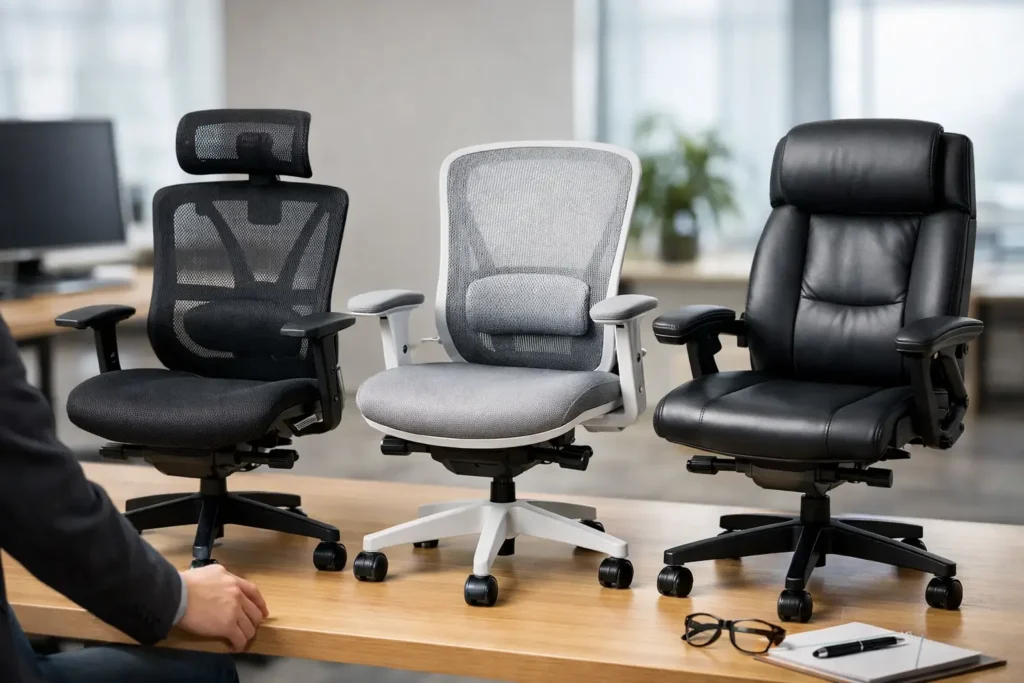
A task chair can look right on a mood board and still fail on the floor by month six. In commercial projects, that gap matters. When you review commercial ergonomic task chairs, you are not just comparing seat comfort for a showroom test sit. You are assessing whether a chair can hold up to daily use, support different body types, align with the design scheme, and stay within procurement realities.
For interior designers, procurement teams, and business owners, the best chair is rarely the one with the longest feature list. It is the one that fits the way the space will actually be used. A corporate office with assigned desks has different demands than a hot-desking workplace, a call center, an admin area in a healthcare facility, or a training room in an education setting. Good chair review starts there – with use case, not marketing claims.
What to look for when you review commercial ergonomic task chairs
The first filter is functional fit. A commercial ergonomic task chair should support long periods of seated work without forcing every user into the same posture. That means adjustability matters, but useful adjustability matters more than excessive controls.
Seat height adjustment is basic, but still non-negotiable. Beyond that, seat depth, lumbar support, back tilt, tension control, and armrest adjustment are the features that usually make the biggest difference in shared work environments. Headrests can be helpful in some executive or extended-use settings, but they are not essential for every project. In fact, for many commercial applications, too many moving parts can create more maintenance issues than ergonomic benefit.
Back support deserves careful review. A mesh back may improve airflow and suit contemporary office schemes, while upholstered backs can feel more substantial and may better complement hospitality-influenced workspaces. Neither is automatically superior. Mesh can sag over time if quality is poor. Upholstery can trap heat or show wear faster if fabric selection is weak. The right answer depends on traffic, cleaning needs, and the overall interior direction.
The seat should feel stable and supportive rather than overly soft. Plush cushioning can impress in a two-minute trial, but in commercial use it may compress quickly or encourage poor posture over a full workday. A firmer, properly contoured seat often performs better over time.
Ergonomics is only one part of the commercial decision
Specifiers sometimes over-focus on user adjustment and under-focus on project compatibility. In a real fit-out, the chair has to work as part of a larger system. That includes workstation dimensions, flooring type, desk heights, circulation clearances, and the visual language of the space.
A chair with a wide base and multiple exposed mechanisms may be technically capable but visually heavy in a refined workplace. On the other hand, an ultra-minimal chair may preserve a clean design line while falling short in high-use staff zones. This is where commercial furniture selection becomes more disciplined than consumer buying. You are balancing performance, appearance, durability, and cost at the same time.
For open-plan offices, acoustic conditions and movement patterns also matter. Casters should roll smoothly without becoming noisy. Arm profiles should allow chairs to tuck neatly under desks where space is tight. In meeting or touchdown areas, visual consistency with lounge and collaborative furniture may be just as important as deep ergonomic tuning.
How to assess build quality before specifying
A chair’s construction tells you far more than a brochure ever will. Start with the base, frame, casters, and mechanism housing. In commercial environments, weak points usually show up in these areas first.
Look for a base that feels planted rather than flimsy. Check whether controls operate cleanly and predictably. Loose levers, uneven tilt response, and excessive wobble are early warning signs. If the armrests shift too easily or feel unstable, they are unlikely to improve under daily use.
Material detailing is another strong indicator. Stitching, edge finishing, mesh tension, molded plastic quality, and the fit between components all point to manufacturing standards. In project supply, consistency matters as much as the sample itself. One approved chair is not enough if later batches vary in finish or feel.
This is why showroom evaluation remains valuable for commercial buyers. A chair should be reviewed in person where possible, not just for comfort but for physical confidence. Reliable suppliers understand this and support hands-on review because commercial seating is a specification decision, not an impulse purchase.
The price question – and what value really means
Commercial buyers are right to be price-sensitive. Seating quantities add up quickly, especially across multi-floor offices, education facilities, or mixed-use developments. But the cheapest chair often becomes the most expensive once replacement cycles, complaints, and inconsistency are factored in.
Value comes from the right level of performance for the application. A premium-spec ergonomic chair may be justified for executive teams, designers, analysts, or staff in full-day seated roles. For training rooms, flexible work areas, or lower-duration use, a simpler task chair may be the more disciplined choice.
That is why review should happen in tiers. Not every zone needs the same chair, and forcing one specification across an entire project can create unnecessary cost. A better approach is to establish where ergonomic performance is critical, where visual alignment matters most, and where a practical balance will do the job well.
For many B2B buyers, the strongest results come from suppliers that can present design-consistent options at different budget levels. That makes it easier to protect the overall concept while staying realistic about procurement targets.
Reviewing commercial ergonomic task chairs by application
In corporate offices, adjustability and daily comfort usually lead the discussion. Staff retention, wellness expectations, and extended computer use all put pressure on seating quality. Here, lumbar support, seat comfort, and mechanism reliability carry real weight.
In healthcare admin areas, durability and cleanability move higher on the list. Fabric choice, surface maintenance, and ease of use become critical because chairs may be used by rotating staff across shifts. Complicated controls are less useful if users do not have time or training to adjust them properly.
In educational settings, furniture often needs to tolerate heavy wear and varied users while remaining cost-efficient. The best chair for this environment is usually straightforward, dependable, and easy to maintain rather than highly customized.
In hospitality-linked workspaces, such as business centers or back-of-house offices, there is often more pressure to align with a refined interior scheme. The chair still needs to perform, but visual integration matters more than in a purely operational setting.
Why supplier capability affects the chair review process
A strong product can still become a weak project choice if the supply process is unreliable. Lead times, batch consistency, customization options, replacement support, and coordination across categories all shape the final outcome.
For specifiers furnishing entire commercial environments, it is rarely efficient to source seating in isolation. A supplier with experience across office seating, collaborative furniture, lounge pieces, tables, and other project categories can simplify approval and help maintain a cohesive result. That matters when clients want design consistency across reception, workstations, meeting rooms, and breakout areas.
This is where a commercial partner such as VCUS can add practical value. Beyond chair selection itself, project teams benefit from showroom review, coordinated specification, and access to styles that support both functional needs and a polished, contemporary interior.
Common mistakes buyers make
One common mistake is approving a chair after a very short sit test. Five minutes tells you whether the chair feels acceptable. It does not tell you how the seat foam will perform, how intuitive the controls are, or whether the back support works for different users.
Another mistake is treating ergonomic claims as equal. Two chairs may both advertise lumbar support and multi-function adjustment, but the quality of those features can differ substantially. What matters is not whether a feature exists, but whether it works well, holds up, and makes sense for the end user.
A third mistake is ignoring the visual and spatial impact of task chairs. In large commercial interiors, seating becomes part of the architecture of the room. Poorly chosen chairs can make a finished office feel cluttered, dated, or inconsistent, even if they perform adequately.
The right review process is more disciplined. Test the chair in context, compare it against the application, question the durability of every adjustment point, and look at the broader project picture rather than the sample alone.
The best commercial ergonomic task chair is the one that supports people properly, fits the design confidently, and performs reliably at the scale your project demands. When those three factors line up, the specification tends to stay right long after installation.
